JamzNG Latest News, Gist, Entertainment in Nigeria
Speaking from Beirut, where he witnessed firsthand the attacks on Wednesday, the World Health Organization (WHO) representative in that country Dr. Abdinasir Abubakar, said that according to the latest figures from the Lebanese Ministry of Health about 300 people died in the attack – one of the highest death tolls in a single day since the return of large-scale hostilities between Israeli forces and Hezbollah militants on March 2. Another 1,150 people were injured.
“There are many more people who are still missing,Dr Abubakar told reporters in Geneva, “They are believed to be under the rubble.”
Many body parts are also waiting to be identified, he said.
Threat to ambulance crews
UN health agency officials also spoke out a warning was received from Israel on Friday morning that “ambulances would also be attacked.”
He said that Israel had warned about “Hezbollah’s use of ambulances”.
WHO emphasized that although health services should not be militarized, misuse of health facilities or ambulances cannot justify attacking them.
“Health workers, facilities, ambulances are all protected under international humanitarian law,said the senior medic.
“Unless we provide these services, we will not be able to save lives.”
On Thursday, WHO also received an alert that Israel’s evacuation order had been expanded in the Jneh area of Beirut to include “two large hospitals dealing with mass casualties. [event]Rafik Hariri and Al Zahara Hospital.”
The facility is currently operating at full capacity. Dr. Abubakar stressed the impossibility of moving 450 patients, including about 50 who were in intensive care after suffering injuries from Wednesday’s bombing, out of health facilities.
Evacuation is impossible
“We decided not to evacuate because we had no other place to evacuate them to [to]Actually,he said.
The UN health agency official added that last night “we received feedback saying that these hospitals will not be attacked… whether that will happen or not, we’ll see.”
Amid the emergency surge in cases, WHO officials noted that even before Wednesday’s mass casualties, the country did not have enough medical supplies to last even a month.
The April 8 airstrike came just hours after a ceasefire was announced between the United States and Iran.
Hostilities between Israel and Hezbollah continue, according to media reports Iran said on Friday it would not take part in peace talks planned for Saturday in Pakistan if the ceasefire was not extended to Lebanon.
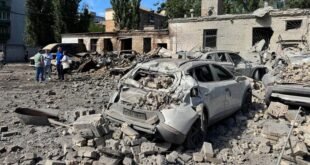
Firefighters survey the scene of destruction in Beirut, Lebanon.
More upheaval
UN Refugee Agency (UNHCRSpokesman ) Eujin Byun said that families who had fled previous conflicts in Beirut, the Bekaa Valley and southern Lebanon – some of whom had begun considering returning after mixed signals about a ceasefire – were now once again uprooted from their homes.
Areas previously considered safe were attacked on Wednesday, he said, “triggering panic and forcing people to flee for a second or third time.”
Byun added that the destruction of the Qasmiyeh Bridge, the main artery connecting the southern cities of Sidon and Tyre, had made “movement between north and south Lebanon much more difficult.”
“For many families in southern villages, returning home is no longer possible because entire communities have been partially or completely destroyed,” he said.
The UNHCR spokesperson emphasized several things An estimated 150,000 people remain in South Korea and humanitarian access to them is critical.
“They need a safe route to escape if they are forced to do it again,” he stressed.
Worsening food security
World Food Program (WFPDirector ) in Lebanon Allison Oman, who was on a convoy to a border village in the south earlier this week, gave reporters an eyewitness account of the situation there.
“What I saw really stuck with me,” he recalled, describing a local bakery whose “glass front had been smashed just an hour before we were there, and they were already sweeping the glass and turning on the oven because they were waiting for the flour we brought in the convoy.”
“Their food supplies were very low, and it was clear that this convoy was eagerly awaited…it was important to help them keep going,he said.
Ms Oman warned that the situation was “quickly becoming a food security crisis,” with food prices rising across the country.
“In just one month, vegetable prices jumped more than 20 percent, bread prices increased 17 percent…for families who are experiencing hardship, this is very concerning,” he said, highlighting the “very worrying combination” of prices rising, incomes being disrupted and demand increasing.
WFP officials also emphasized that in conflict-affected areas in southern Lebanon, more than 80 percent of the market is no longer functional.