JamzNG Latest News, Gist, Entertainment in Nigeria
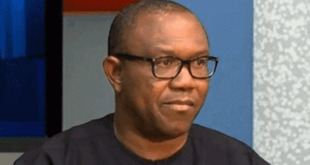
Chairman of the Peoples Democratic Party (PDP) in Ogun State, Segun Showunmi, has stressed the need to invest in strategic communications to build a better image of the state.
Showunmi, who was the spokesperson for former Vice President Atiku Abubakar, stated this in a statement published on Saturday.
His comments contradict the backlash that emerged following a recent interview between Mehdi Hasan and President Bola Tinubu’s Special Adviser on Media Communications and Policy, Daniel Bwala, in a program broadcast on Al Jazeera.
A clip of the interview circulating on social media immediately sparked a backlash, with critics describing Bwala’s departure as embarrassing.
The PDP chief argued that public communications at the highest levels of government is not an ordinary job, and that the role of spokesperson is one of the most demanding duties in political leadership as the office sits at the intersection of policy, perception and national reputation.
He said, “Every word, tone, gesture and response becomes part of the narrative used by domestic and international audiences to judge a government.”
Showunmi said recent interview appearances by presidential representatives have reignited important conversations about the professional standards required for spokespeople in the modern media environment.
He explains, “Facing an experienced international interviewer like Mehdi Hasan is not just a media appearance; it is a high-stakes exercise in narrative management.
“Effective spokespeople rarely act by chance. Communications experts often refer to the ‘10,000 hour rule,’ popularized by Malcolm Gladwell, to describe the level of sustained practice required to achieve mastery in a complex profession.
READ ALSO: SERAP takes Nigerian government to ECOWAS Court over ‘unlawful mass telephone tapping regulations’
“Political communications is no different. Those who excel in this area typically have years of disciplined engagement – campaign messaging, media briefings, crisis communications and policy translation.
“The difference between experienced communicators and those without becomes clear when under pressure.”
Showunmi adds, “Professional spokespeople understand how to deflect hostile or loaded questions without appearing evasive.
“They rely on a structured communications framework often summarized as a ‘4+1’ approach: four supporting points underpinned by one key message that consistently returns the conversation to the policy priorities of the actors.
“Interviews are never about the spokesperson. They’re about defending, explaining and contextualizing the decisions of the leader or institution they represent.”
He further stated that, “For government, the broader lesson is institutional rather than personal. Strategic communications must be treated as a professional discipline that requires ongoing training, mentoring and preparation.
“Many successful governments invest heavily in communications war rooms, message simulation exercises, and spokesperson training to ensure that representatives are fully prepared for hostile interviews.
“In an era where a single media appearance can circulate globally in a matter of minutes, the performance of a spokesperson is no longer a trivial matter in government. It is part of statecraft.
“Nigeria, like many other democracies, would benefit from greater investment in professional communications training for those tasked with representing public institutions. This would not only strengthen the credibility of individual leaders but also the country’s voice on the global stage.
“Competency in this area is rarely determined by instinct. Competency in this area is the result of preparation, experience, and respect for strategic communications skills.”