JamzNG Latest News, Gist, Entertainment in Nigeria

US President Donald Trump gave Iran 48 hours to reopen the Strait of Hormuz to shipping or face the destruction of its energy infrastructure, as Tehran launched its most destructive attack on Israel.
The ultimatum, issued just a day after the US president said he was considering “shut down” military operations after three weeks of war, came as the key oil passage remained effectively closed and thousands more US Marines headed towards the Middle East.
Trump wrote on Truth Social that the US would “strike and obliterate” Iran’s power plants, “starting with the largest one first,” if Tehran did not fully reopen the strait within 48 hours, or 11.44pm GMT on Monday according to the time of his post.
Iranian Foreign Minister Abbas Araghchi said Tehran had imposed restrictions only on ships from countries involved in attacks on Iran and that it would help others left out of the conflict.
In response to Trump’s threat, the Iranian military said it would target energy and desalination infrastructure “belonging to the United States and the regime in the region,” according to the Fars news agency.
Trump’s ultimatum came just hours after two Iranian missiles struck southern Israel, wounding more than 100 people in the most destructive attack since the war began. The Israeli Prime Minister, Benjamin Netanyahu, promised to react “on all fronts”.
The attacks, which managed to penetrate Israeli missile defense systems, ripped apart the facades of residential buildings and dug craters in the ground.
First responders said 84 people were injured in the city of Arad, 10 of them seriously. Hours earlier, 33 people were injured in nearby Dimona, where AFPTV footage showed a large hole gouged into the ground next to piles of rubble and twisted metal.
Dimona is home to a facility widely believed to be the site of the Middle East’s only nuclear arsenal, although Israel has never admitted possessing nuclear weapons.
The Israeli military told Agence France-Presse that there had been a “direct missile hit on a building” in Dimona, with casualties reported at multiple sites, including a 10-year-old boy in serious condition with shrapnel wounds.
*Netanyahu promises to continue to strike Iran*
Hours later, the Israeli military said its forces had launched a wave of attacks on Tehran.
Iran said the attack on Dimona was retaliation for Israeli attacks on its Natanz nuclear facility, while the Islamic Revolutionary Guard Corps (IRGC) said forces also targeted other southern Israeli cities and military sites in Kuwait and the United Arab Emirates.
After the Natanz attack, the head of the United Nations Nuclear Observatory, Rafael Grossi, reiterated his call for “military moderation to avoid any risk of a nuclear accident.”
The Natanz facility hosts underground centrifuges used to enrich uranium for Iran’s controversial nuclear program; suffered damage in the June 2025 war.
The Israeli military denied being behind the attack on Natanz but said it struck a facility at a university in Tehran that they said was being used to develop nuclear weapons components for Iran’s ballistic missile program.
The United Arab Emirates (UAE) said on Saturday it faces airstrikes after Iran warned it against allowing strikes from its territory on disputed islands near the Strait of Hormuz.
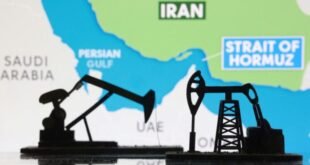
Iran has choked off the vital waterway, which carries a fifth of the world’s peacetime crude oil trade.
The standoff has sent crude oil prices soaring, with North Sea Brent crude now trading above $105 a barrel, as the long-term consequences for the global economy become a grave concern.
France, Italy, Germany, South Korea, Australia, the United Arab Emirates and Bahrain – condemned the “de facto closure of the Strait of Hormuz by Iranian forces”.
“We express our readiness to contribute to appropriate efforts to ensure safe passage through the Strait,” they said.
Trump called NATO allies “cowards” and urged them to protect the strait.
Japan said on Sunday it may consider using its armed forces for mine clearance in the Strait of Hormuz if a ceasefire is reached.
Foreign Minister Toshimitsu Motegi said: “If there was a complete ceasefire, hypothetically speaking, then things like demining could happen.
“This is purely hypothetical, but if a ceasefire was established and naval mines created an obstacle, then I think that would be something to consider,” Motegi told Japanese TV.
Japan’s military actions are limited by its pacifist postwar constitution, but 2015 security legislation allows Japan to use its Self-Defense Forces abroad if an attack, even against a nearby security partner, threatens Japan’s survival and no other means of dealing with it are available.
Japan receives about 90% of its oil shipments through the strait, which Tehran has largely closed during the war, now in its fourth week.