JamzNG Latest News, Gist, Entertainment in Nigeria
A former Senator representing Ogun Central Senatorial District, Senator Femi Okurounmu, said Nigeria’s 1999 Constitution structurally favors the Northern Region, warning that the imbalance continued to impact governance outcomes and exacerbate political and economic challenges across the country.*
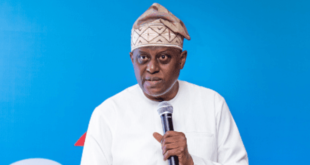
Speaking during an exclusive interview on Frontline, a current affairs program on Eagle 102.5 FM, Ilese-Ijebu, Ogun State, on Wednesday, the elder statesman of the First Senate examined the relationship between democratic governance and economic policy, raising concerns about the foundation on which Nigeria’s democracy is built. He argued that without addressing these structural concerns, national development efforts could continue to face significant setbacks.
Okurounmu, head of the pan-Yoruba socio-political organization Afenifere, argues that the current constitutional framework has created a system where political power is distributed unequally, thus influencing decision-making at the highest levels of government. He emphasized that this imbalance has not only shaped legislative outcomes, but also influenced policy direction and governance priorities over time.
“I will let you know that the problem is much more complicated than that. I told you, the 1999 constitution has more or less tilted all the government structures in favor of the north. The north has infiltrated the central government so much that whoever is the president does not matter. The north still controls the government. Whoever is the president of Nigeria at this stage with our current constitution and with the current government structures does not matter.
According to him, the implications of such structural inequality are far-reaching, particularly in a diverse country like Nigeria, where fair representation is fundamental to unity and stability.
1999 Constitution as a military imposition
The former MP described the 1999 Constitution as lacking democratic legitimacy, insisting that it was not the product of popular participation but rather a document imposed by the military.
He traced its origin to the administration of former Head of State, General Sani Abacha, stressing that the process that led to its adoption did not involve adequate consultation with Nigerians. This, he said, continued to raise questions about its credibility and acceptance among citizens.
He said: “The 1999 constitution was simply a decree that Abacha published and made into a constitution for us. And that so-called constitution wasn’t even made known to the public until after the elections, so even the president who was taking over didn’t know, he wasn’t aware of the constitution that he was going to govern under when he was contesting the elections. So, I would say it wasn’t really a constitution, it was a decree and Abacha just published and passed it into a constitution and handed it over to the president after the election”.
Okurounmu further argued that the Constitution shares significant similarities with the 1979 Constitution, which he said also contained structural imbalances that persist in the current system. He noted that these inherited characteristics have continued to influence governance models in ways that are not entirely equitable.
“And many of the provisions are very similar to that of the 1979 constitution which, you know, was designed by Murtala Muhammad and Obasanjo and most of the provisions of that constitution are very unjust as far as governance in Nigeria is concerned. The 1999 constitution which, as I said, is a close relation to the 1979 one virtually gives veto power to the north on how Nigeria will be governed. All the governance structures are tilted towards the north.” He added.
Structural imbalance and the North’s advantage
Expanding on his position, Okurounmu said the current political structure gives the Northern region a numerical advantage in the National Assembly, thus shaping legislative outcomes.
He explained that the number of states and local government areas in the North directly translates into greater representation in both the Senate and the House of Representatives. According to him, this imbalance has significant implications for national legislative and decision-making.
He said: “The North has advantages in the number of states and that means it also has advantages in the number of senators in the National Assembly. The North has advantages in the number of local governments, which means it also has an overwhelming advantage in the number of members of the House of Representatives in the National Assembly. So when you look at our legislatures, the Senate and the House of Representatives, in reality that House is a House where the North holds veto power because no decision can be made in those chambers unless the North agrees with it’s…”
The former senator added that such dominance creates a situation in which other regions may feel marginalized, thus fueling unrest and dissatisfaction. He stressed that for a federation to function effectively, there must be a sense of balance and fairness in representation.
Failed attempts at restructuring
Okurounmu also reflected on decades of efforts to restructure Nigeria, noting that several initiatives have been undertaken without producing significant results.
He recalled his involvement in various reform movements and political discussions, including his role in the 2014 National Conference, convened to address some of the country’s structural challenges. According to him, the conference produced recommendations that could significantly improve governance.
He said: “We have spent years advocating for restructuring and have participated in processes intended to correct these imbalances, including the 2014 National Conference. That conference developed recommendations that, if implemented, would bring some level of equity and efficiency to the system. Unfortunately, those recommendations were ignored and have remained largely unimplemented ever since despite their potential benefits.”
He expressed disappointment that successive administrations have not demonstrated the political will needed to implement these reforms. It argued that failure to implement these recommendations contributed to the persistence of governance challenges.
Limits of presidential power
The elder statesman further argued that the current constitutional structure limits the effectiveness of elected leaders, including the president. He suggested that the system itself, rather than the individuals in charge, plays a more significant role in determining governance outcomes. That, he said, explains why changes in leadership have not necessarily translated into substantial improvements.
“Whoever is president under this Constitution doesn’t really matter what you think, because the structure itself controls governance. The way power is distributed and exercised makes it difficult for any president to implement far-reaching changes, even if he intends to do so. That’s why we continue to see similar challenges persist across administrations.” He said.
Okurounmu noted that the administration of President Bola Ahmed Tinubu also operates within these limits. He argued that without structural reforms, expectations of transformative governance may remain unfulfilled.
Insecurity and systemic challenges
On the issue of insecurity, Okurounmu linked the country’s security challenges to broader systemic and structural issues within governance.
He argued that the persistence of violence and instability cannot be fully understood without examining the underlying political framework. According to him, the current situation reflects deeper problems that go beyond isolated incidents.
He said: “When you look at the insecurity situation in Nigeria today, it is not something that can be explained away as mere criminality or isolated acts of violence. There are deeper systemic issues at play and these issues are linked to the way the country is structured and governed. Until we address these underlying issues, it will be difficult to achieve lasting peace and stability.”
He stressed that addressing insecurity requires not only military or security responses, but also political and structural solutions.
Okurounmu also touched on the ongoing agitation for an Igbo nation, noting that while the aspiration for self-determination is not inherently wrong, the methods employed by some separatist groups raise concerns.
He stressed that the use of force, intimidation and internal conflict undermines legitimate demands for independence and peace. According to him, if ethnic nationalities engaged in dialogue and pursued their goals through peaceful and structured means, achieving self-government or autonomy could be feasible without resorting to violence. He said: “The Biafrans are agitating for an Igbo nation. The agitation itself is not bad; it is the way they are doing it that is not good. They are doing it using force and intimidation, even killing each other. But if all the ethnic nationalities come together and decide that the way to have peace is for each to have their own nation, why not?”
Call for national dialogue
Okurounmu warned that Nigeria could become increasingly difficult to sustain as a unified entity if current challenges are not addressed.
He called for a new national dialogue on the future of the country, underlining the need for an inclusive dialogue between all ethnic nationalities. According to him, such discussions are necessary to determine a viable and peaceful path forward.
He said: “The country is becoming unsustainable as a single nation if we continue with this structure without making the necessary changes. What we need now is a sincere and honest dialogue between all the ethnic nationalities that make up Nigeria, so that we can decide on a framework that ensures peace, fairness and mutual respect. Without this, we risk deepening the divisions that already exist.”
While acknowledging that previous restructuring efforts have failed, Okurounmu insisted that the conversation must continue.
He concluded by urging political leaders and stakeholders to prioritize national unity and fairness in addressing the country’s challenges, warning that failure to do so could have long-term consequences for Nigeria’s stability.