JamzNG Latest News, Gist, Entertainment in Nigeria
It remains unclear whether mines, which can sink any type of ship if activated, have been deployed in the Strait of Hormuz, as part of the ongoing conflict in the Middle East.
Most shipping has not been able to pass through the strategically important strait as Iran continues its war with the United States, Israel and other countries in the region, amid ongoing bombing of Iranian targets.
Reopening the strait remains a key goal of the global community to facilitate the flow of oil and fertilizer.
Paul Heslop is an expert at the UN Mine Action Service (UNMAS) which focuses on clearing land mines.
He spoke with UN News’ Nathalie Minard ahead of the conference International Day for Mining Awareness and Aid is marked annually on April 4.
UN NEWS: Do you have information about sea mines deployed in the Strait of Hormuz?
Paul Heslop: We know that the Iranian navy had a large stockpile of sea mines before the conflict.
Paul Heslop, UNMAS
We do not yet have definitive reports stating the exact number or type of mines that have been used, but sea mines are relatively easy to deploy.
You can take it out in a fairly small boat, a fishing boat, a dhow, or a special mining vessel.
UN NEWS: What types of sea mines can be deployed?
Paul Heslop: If you consider land mines, they are usually placed above or below the surface. And once installed, it stays in place, unless an earthquake, landslide, or large amount of water moves it.
The challenge facing sea mines is that sea mines can be laid in three layers: floating on the surface, floating in the water, or placed at the bottom of the seabed.
Of course, if it floats, it is vulnerable to tidal currents and can move location. They can also be anchored and secured in one location.
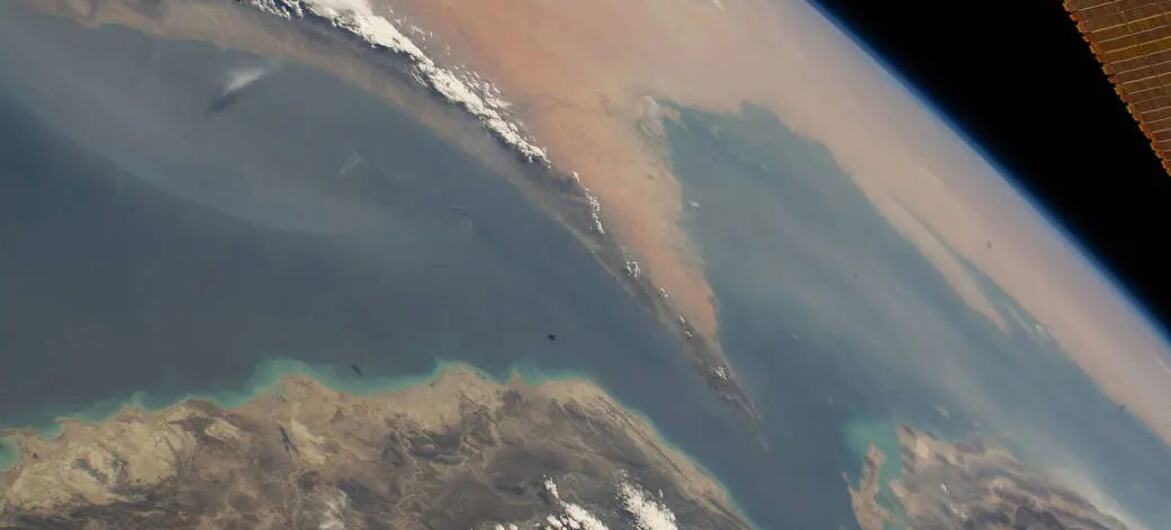
Satellite photos show strategically important shipping routes in the Strait of Hormuz.
They can be made of plastic or metal. Its activation mechanisms include contact with the ship’s hull, magnetic influence, or it can be detonated remotely, or timed to detonate.
UN NEWS: Why are sea mines harder to clear?
Paul Heslop: Clearing land mines is difficult, but clearing sea mines is even more difficult.
Not only are you working in three different depths, so three dimensions, but also a fourth dimension, which is time.
Over time, the mine may move. If an area is cleaned, and a tidal wave or other current occurs, then the area may become contaminated again.
In addition, some mines move underwater, driven by propellant mechanisms so that deminers work in a dynamic and changing environment.
UN NEWS: How to detect it?
Paul Heslop: If the object is made of metal, a magnetometer (which measures changes in magnetic fields) will find it. There is also a series of sophisticated sonar (sound wave) and radar (radio wave) detection tools to locate underwater devices.
Another challenging factor in water is the temperature layer which can act as a reflector and make detection difficult.
So, if a mine is at a depth that has different temperature layers above it, and sonar has been installed, the sonar may be degraded or deflected because of those temperature layers.
This is why finding and clearing sea mines is so challenging and so dangerous for the ships doing it.
UN NEWS: Which countries have minesweepers and the capability to carry out technical intervention in certain maritime mine areas?
Paul Heslop: Most navies have the capability to handle mines.
This conflict occurs at a time of transition from old-fashioned, crewed minesweepers to new technology that uses drones or underwater robots to find mines.
UN NEWS: If sea mines prove to be a threat to shipping, what is the solution so that traffic can return to normal once peace is restored?
It’s like in a peacekeeping mission: you might have a group of rebels who, at night, go and plant mines on the roads to target convoys.
So, every morning, you go on patrol in a mine-protected vehicle to make sure there are no mines laid the night before.
If there is a peace agreement or agreement in the Strait of Hormuz and mines have been deployed, then in the future, there may be a requirement, due to the dynamic nature of sea mines, to form convoys and sweep mines in front of those convoys.
A convoy might operate in a channel several kilometers wide that has been cleared of mines. It is impossible for every square meter of the Strait of Hormuz to be cleaned every day.
And of course, depending on currents and tidal shifts, some areas are more likely to experience recontamination than others.