JamzNG Latest News, Gist, Entertainment in Nigeria

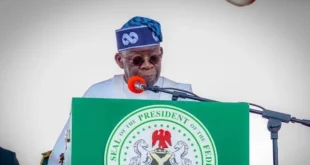
President Bola Ahmed Tinubu has renewed Nigeria’s call for reform of the United Nations Security Council, insisting that Africa be given at least two permanent seats with full rights and responsibilities, including veto power while the privilege remains in place.
The President stated this in Nigeria’s national statement released by Vice President Kashim Shettima during the General Debate of the 81st Session of the United Nations General Assembly in New York.
The President stated that the composition of the Security Council no longer represents contemporary geopolitical realities, declaring that the world of 2026 cannot continue to be governed by a power arrangement created in 1945.
He said Africa should also receive five non-permanent seats in accordance with the Ezulwini Consensus and the Sirte Declaration, which articulate the continent’s common position on reforming the global body.
The President argued that Africa’s continued exclusion from permanent membership undermined the credibility, fairness and effectiveness of the Council, particularly when many of the issues addressed directly affected the continent.
He affirmed Nigeria’s readiness to take on greater responsibilities in global affairs, highlighting the country’s long-standing contributions to peacekeeping, conflict mediation and security operations across Africa.
The President cited Nigeria’s interventions in Liberia, Sierra Leone, Darfur, Mali and Gambia as evidence of its commitment to peace, stability and democratic order on the continent.
He also reaffirmed Nigeria’s commitment to multilateralism, saying that diplomacy, cooperation and international law must prevail over coercion, isolation and the arbitrary exercise of power.
According to him, the United Nations remains indispensable for international peace, justice and sustainable development, but must become more inclusive, representative and responsive to current challenges.
On the economic front, the President linked Nigeria’s foreign policy objectives to reforms implemented at home.
He said sound macroeconomic management, stronger institutions, targeted investments and private sector expansion are essential for sustainable growth and national prosperity.
The President also called for fundamental reform of the international financial architecture to give developing countries greater access to concessional financing and fairer debt arrangements.
He said existing debt systems should allow developing countries to invest in education, healthcare and infrastructure instead of forcing them to choose between servicing debt and meeting the basic needs of their citizens.
The President identified the African Continental Free Trade Area as a powerful tool for the economic transformation of the continent.
He urged African countries to reduce their dependence on commodity exports and embrace value addition, manufacturing, innovation and knowledge-based manufacturing.
On climate change, the President rejected what he described as a false choice between development and climate action.
According to him, developing countries must be allowed to industrialize, create jobs, reduce poverty and expand access to energy, while pursuing low-carbon development.
He called for predictable climate finance, technology transfer and capacity building, stressing that global climate responsibility should be grounded in equity and collective obligation, rather than treated as an act of charity.
The President reaffirmed Nigeria’s Energy Transition Plan and its goal of achieving net-zero emissions by 2060 through renewable energy, clean cooking, gas as a transition fuel, climate-friendly agriculture and nature-based solutions.
On technological progress, the President urged world leaders not to give in to fear about the future of artificial intelligence.
He said artificial intelligence should be used responsibly to improve healthcare, education, agriculture, governance and economic productivity.
He called on global partners to invest in Nigeria’s young population and growing technology sector, highlighting that the country is expanding digital public infrastructure, broadband access, research and technology entrepreneurship.
On international security, the Nigerian leader called for greater intelligence sharing, tougher controls on terrorist financing and decisive action against the illicit movement of weapons.
He said military victories against terrorism and violent extremism must be supported by education, economic opportunity, responsible governance and social inclusion to address the conditions that allow insecurity to thrive.
The President also called for renewed diplomatic action to end the conflict in Sudan and other troubled regions.
He said civilians must be protected, humanitarian organizations must have free access and international law must be respected by all parties.
The President promised that Nigeria will continue to choose cooperation over confrontation, dialogue over division and partnership over isolation.
He argued that an inclusive, effective and properly reformed United Nations remains humanity’s best platform for addressing war, poverty, inequality, climate change and other threats that no country could defeat alone.