JamzNG Latest News, Gist, Entertainment in Nigeria
In the Ukrainian conflict, landmine technology set a precedent for a new era of development. 3D printers are used to produce basic models of land mines close to the battlefield, which can then be easily assembled, filled with explosives, and dropped by drones.
In fact, most of the mines deployed in Ukraine today are installed remotely, either by artillery, rockets, helicopters or drones.
“We are also seeing more and more high-tech mines being deployed,” making landmine detection “a much more complex and dangerous task,” said Paul Heslop, Head of the Research and Development Agency. United Nations Mine Action Service (UNMAS) in Ukraine.
These “high-tech” land mines are equipped with sensors that can detect approaching mines, whether on foot or by vehicle, and then explode. Some even have magnetic influence capabilities, meaning they can explode if exposed to the detector’s magnetic field.
“The technology you use to find mines may actually activate those mines,” said Mr. Heslop.
As The International Day for Mine Awareness and Assistance in Mine Action is celebrated every April 4UN mining experts say the biggest challenge is winning the arms race to clear land faster than developing technology to stop that land clearing.
Drones are tools, not solutions
Deminers focus on prevention and finding new solutions to help protect civilian lives and reduce the damage that landmine contamination causes to their communities.
One way mine action groups innovate is by exploiting weaknesses in the way landmines are placed.
With more and more mines being deployed remotely, many do not penetrate the surface. This makes detection with drones and advanced sensor technology easier than if buried by hand beneath the surface.
From there, remotely controlled technology, such as drones or robots, is able to emit small payloads or flares to neutralize the threat.
However, against the backdrop of increasing conflict around the world, this progress is disproportionate to the number of mines planted around the world.
“Since 2015, more contamination has been created every day than has been cleaned up,” Mr. Heslop.
UNMAS estimated last year that more than 20 percent of Ukraine’s land, 139,000 square kilometers covering more than six million people, is contaminated by mines or unexploded ordnance and costs the economy more than $11 billion a year.
Although land mines pose a threat to life, many mines, such as anti-personnel land mines are specifically designed to harm. Ukraine alone has more than 60,000 amputees as a result of the war.
The ‘perceived contamination’ of landmines is also what makes landmines such a dangerous military tool: the fear of concealed weapons makes land inaccessible, thereby having a widespread impact on millions of civilians.
What are the priorities?
Prioritization is key as humanitarian mine clearers seek to maximize how they can restore people’s lives in areas that may require decades of attention to return to normal.
Traditionally, landmine action is measured based on results: how many mines have been cleared, or square meters cleared, or even how many metal fragments have been removed.
“I think the other thing you have to remember in demining, or in demining for humanitarian purposes, the goal is not necessarily to clear the mines; the goal is to demonstrate that the land can be used for more productive purposes,” Heslop said.
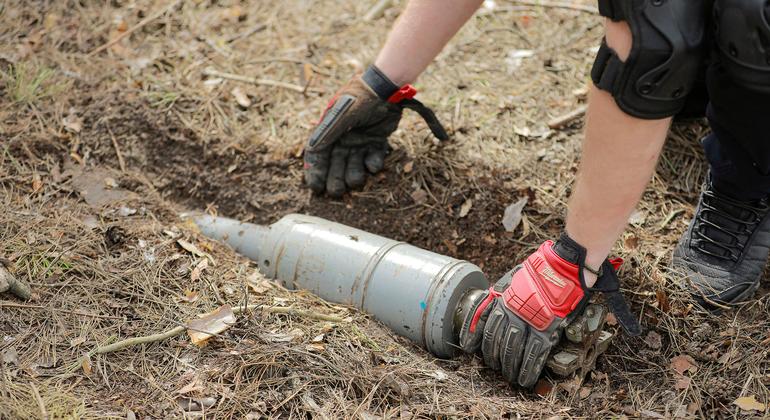
Humanitarian deminers approach the problem in two ways: proving that mines do not exist and that the land can be used; and second, proving that there is a high probability that the mines can begin to be cleared.
However, there is often uncertainty regarding the existence of landmines. Especially in ‘high metal content areas’ such as in combat zones where artillery fire has scattered thousands of pieces of metal shrapnel, and sensors find it difficult to differentiate between land mines and shrapnel.
This uncertainty in detection makes “mine action a fundamentally inefficient process”, said Mr. Heslop.
To meet this need, new technologies have been developed that do not look for metal in mines, but can detect explosives or even identify plastic casings around explosives.
Sometimes, the old ways are the best
Moving forward, Heslop warned deminers “not to be too dogmatic about our approach,” and added that one of the biggest obstacles to progress lies in “mindset.”
New technologies can be combined with older techniques and technologies, previously considered inefficient, to help increase efficiency in demining and detection.
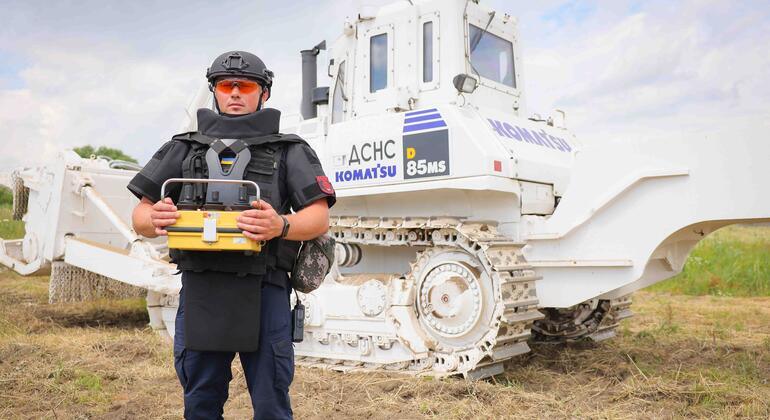
One approach is to use AI, high-resolution cameras and drones alongside mine rollers to help provide confidence to skeptical civilians who use the land like farmers.
AI and sensors can be used to determine whether a field is mine-free, rollers can then traverse the field to help reassure farmers that it is safe to use tractors.
“It’s a combination of going back to old ideas and seeing if we can use them, looking at new ideas and new technology” he said.
Artificial Intelligence, amplifier
If there is a high probability of mines in an area, combining AI with advanced scanning technology can also help reduce mine detection predictions, so that an area the size of a football pitch can be reduced to an area as small as a goalkeeper’s six-yard box.
It is this efficiency that enables AI to cut mine action costs but also speed up the return to productive land use.
Similarly, AI can also be used to aid data-driven decision making, by processing large amounts of data to make decisions about which areas to prioritize to gain maximum benefit in just a matter of seconds.
This is a job that usually requires many hours of manual labor from experienced mine action leaders.
Communication technology helps prevention
While technology is partly responsible for the increased danger posed by landmines, innovation has also made communication of landmine awareness much more effective.
“Today, if you see something dangerous, you can take a picture of it, send it in, and someone will look at it and say, ‘Yeah, that’s dangerous stuff, we’re going to send a team,’ or ‘No, that’s a car part… that’s an oil filter or an air filter,’” said Mr. Heslop.
One example, Heslop said that a program in Afghanistan which aimed to reach more than 200,000 people, was able to reach more than five million people thanks to the technology owned by civil society.
“I think the increased communication from new technology and the ability to respond is much better than it was 30 years ago.”