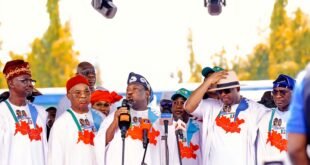
Because nnpp has expelled the legislator of Kano Abdulmumin Jibrin Kofa – Official

Untitled Design 91

The chapter of the Kano state of the new Nigeria People’s Party (NNPP) has expelled Abdulmumin Jibrin Kofa, member of the Chamber of Representatives of the Federal Electoral College of Kiru/Bebeji, for alleged anti-party activities.

The president of the party hashim Dungurawa said that the repeated explosions of the media of Jibrin against the nnpp and his leadership have pushed the expulsion.

He described Kofa as a “weak politician” whose victory was possible only through the Kwankwasiyya movement and the NNPP platform.

“If he had been really strong, he would have won under the APC. His success came through Nnpp and Kwankwasiyya,” said Dungurawa.

He added that a reconciliation committee had tried to involve Jibrin after the television interview of the channels, but the subsequent observations of the legislator passed the line.

“The loyalty outside the party openly declared. That’s why it was expelled,” explained the president.

Dungurawa rejected the speculation that Jibrin could return to the APC, saying that he would not have weakened the nnpp, who remains strong under the senator Rabiu Musa Kwankwaso.

Previously, the party had suspended four other Kano legislators for alleged anti-play behaviors.

Those suspended are senator Kawu Sumaila, Kabiru Alhassan Rurum, Ali Madakin Gini and Sani Abdullahi Rogo.


Check Also

Freedom of Information Act and The Limits of Press Freedom, By Mack Ogbamosa – THISAGE

        Introduction  A free, independent, and vibrant press is one of the strongest pillars of any democratic society. It is against this background that most democratic countries  make constitutional provisions for a free press . Others even go further to enact specific laws to make affairs of governments freely available to the public. Currently, there are more than  130 countries in the world that have free press laws. They include Sweden, United States, France, South Africa and Nigeria. Nigeria did not only make  constitutional provisions in Sections 22 and 39(1) of the 1999 Constitution ( as amended) but also went ahead to enact the Freedom of Information Act  in 2011. Section 22 of the 1999  Constitution states: “ “The press, radio, television and other agencies of the mass media  shall at all times be free to uphold the fundamental objectives contained in this chapter( ie Chapter II) and uphold the responsibility and accountability of the Government to the people”  Section 39(1)  of same Constitution states : “Every person shall be entitled to freedom of expression, including freedom to hold opinions and to receive and impart ideas and information without interference” ..  To complement these constitutional provisions, Section 1 (1) of the Freedom of Information Act (FOIA) states “Notwithstanding anything contained in any other Act, law or regulation, the right of any person to access or request information, whether or not contained in any written form, which is in the custody or possession of any public official, agency or institution howsoever described, is established.” while Section  2(2), states that: “A public institution shall ensure the proper organization and maintenance of all information in its custody in a manner that facilitates public access to such information”  Primary Purpose of FOIA  According to the Act, its primary purpose is to make information about public records freely available to every Nigerian in the public interest. …

Leave a Reply

Your email address will not be published. Required fields are marked *