JamzNG Latest News, Gist, Entertainment in Nigeria
Post views: 29
By Osondu Ohaeri
In Nigeria’s road transport ecosystem, tanker and trailer operations remain one of the most critical yet high-risk segments. From devastating fuel explosions to multi-vehicle collisions, the consequences of articulated vehicle accidents have historically been severe, causing fatalities, destroying property and disrupting economic activity. Between 2020 and early 2025 alone, tanker-related accidents caused at least 555 deaths nationwide, underscoring the urgency for sustained intervention.
Against this backdrop, the Federal Road Safety Corps (FRSC) has stepped up a multi-pronged strategy aimed at reducing accidents involving tankers and trailers, with measurable results starting to emerge.
Strengthening regulatory oversight: the Safe-to-Load initiative
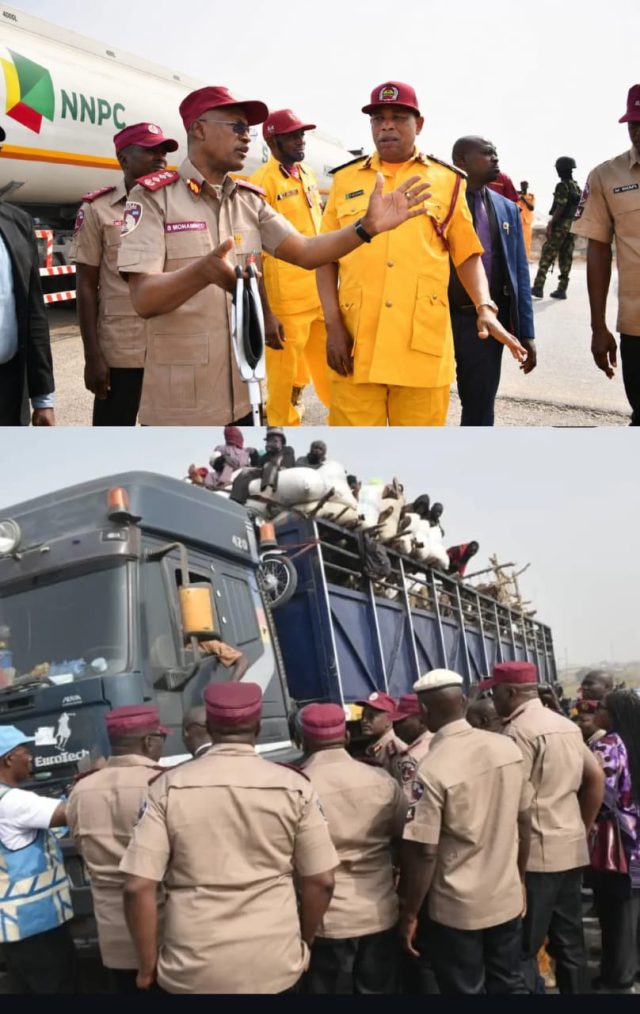
At the heart of FRSC’s intervention is the Safe-to-Load program launched in 2015, a regulatory framework designed to ensure that only roadworthy tankers and qualified drivers are allowed to transport petroleum products and other heavy cargoes.
With this system:
Vehicles undergo pre-load inspection at tank depots as only trucks that meet safety standards are allowed to operate. Drivers must also be in possession of valid driving licenses and certification of suitability. The initiative directly addresses long-standing problems such as mechanical failures, overloading and the use of unqualified drivers, factors historically linked to accidents. As of late last year, the Corps recorded a milestone achievement with notable improvement in Class G driver’s license compliance among tanker drivers, rising from 58.2 percent in 2015, when the Safe-to-Load program launched, to 99.4 percent at the end of 2025.
Impressed by this development, Corps Marshal Shehu Mohammed said “the Safe-to-Load initiative was designed to ensure a safe driving environment for tankers carrying wet cargoes and the recent results reflect sustained regulatory enforcement and strong collaboration with stakeholders.”
The Corps Marshal further stated that “the achievement highlights the Corps’ commitment to ensuring that only qualified and professionally certified drivers operate high-risk vehicles on Nigerian roads, improved licensing compliance has also directly contributed to improved safety outcomes, reduced operational risks and increased professionalism in the petroleum transportation sector.”
Under the same initiative, FRSC also recorded a notable 61.29% reduction in fatalities and a 15.53% decline in accident severity index in 2025, attributed to the effective implementation of the Safe-To-Load program. Noteworthy is that this program has transformed compliance levels in the oil transportation sector with a strong alliance with critical stakeholders
Application of safety technologies and standards
The Corps has stepped up enforcement of critical safety requirements for articulated vehicles, including the installation of speed limiting devices, the installation of critical safety components such as the API Standard Leak Proof System that provides comprehensive guidelines for the design, construction and maintenance of welded steel tanks, ensuring they meet the highest safety performance criteria, and the use of retroreflective tape for nighttime visibility
Obligation to register and comply with vehicle documentation The FRSC has also implemented a robust control mechanism against overloading and defective tyres. These interventions are intended to mitigate common accident triggers such as excessive speed, poor visibility and brake failure.
Driver training, certification and reorientation
Recognizing the human factor in causing accidents, FRSC has prioritized the development of the skills of tanker and trailer drivers. This includes regular training and retraining programs and working with industry regulators to deepen safety training. Promoting mandatory certification schemes for transportation drivers and complementary efforts such as Minimum Industrial Safety Training for Downstream Operations (MISTDO) strengthen driver competence and safety awareness throughout the oil transportation chain.
Data-driven enforcement and incident investigation
In partial fulfillment of its core mandates, FRSC has also institutionalized post-accident investigation mechanisms to analyze tanker and trailer accidents. The results of these investigations inform policy adjustments, enforcement focus areas, and public safety advisories. This evidence-based approach ensures that interventions are not reactive but preventative and adaptive.
Robust public awareness campaigns
Public behavior has also been identified as a contributing factor, particularly the dangerous practice of fuel sampling during tanker accidents. In response, FRSC intensified mass media campaigns warning against fuel levying through television commercials, radio jingles, and talk shows. Community outreach programs e
Stakeholder engagements with transport unions and oil traders aim to reduce secondary casualties often associated with tanker explosions, such as the tragic 2025 accident near Suleja that killed more than 100 people.
Collaboration between multiple stakeholders
FRSC’s strategy is anchored on collaboration with petroleum regulatory agencies, transport unions (NARTO, NUPENG), safety agencies and state traffic management bodies. This integrated approach ensures that safety compliance is enforced across the entire logistics value chain, from loading points to highways. It also marks a significant milestone in Nigeria’s road safety efforts and validates the Corps’ strategy of combining enforcement, education and stakeholder engagement.
Challenges
Despite these achievements, several structural and fundamental issues continue to pose some level of challenges in the Corps’ concerted efforts to curb the threat of oil tanker-related accidents, such as aging transportation fleet, driver fatigue due to long-distance transportation, limited rest areas for truckers, high dependence on road transportation for oil distribution.
Noteworthy at this juncture is the evolution of the FRSC strategy which reflects the shift from routine application to systemic risk management in the transport sector. By integrating regulation, technology, training and public education, the Corps is gradually reducing the frequency and severity of tanker and trailer accidents on Nigerian roads. Sustaining these achievements will depend on continued enforcement, improved infrastructure and deeper collaboration between stakeholders. Ultimately, safer tanker and trailer operations are not just a regulatory goal, but are a national imperative related to public safety, economic stability and the protection of lives.
Osondu Ohaeri, a Fellow of the Nigerian Institute of Public Relations is the Deputy Corps Commander and Public Education Officer at the FRSC National Headquarters in Abuja.