JamzNG Latest News, Gist, Entertainment in Nigeria
The rain is falling. The track is cracked. And Demilade Ajayi is still running.
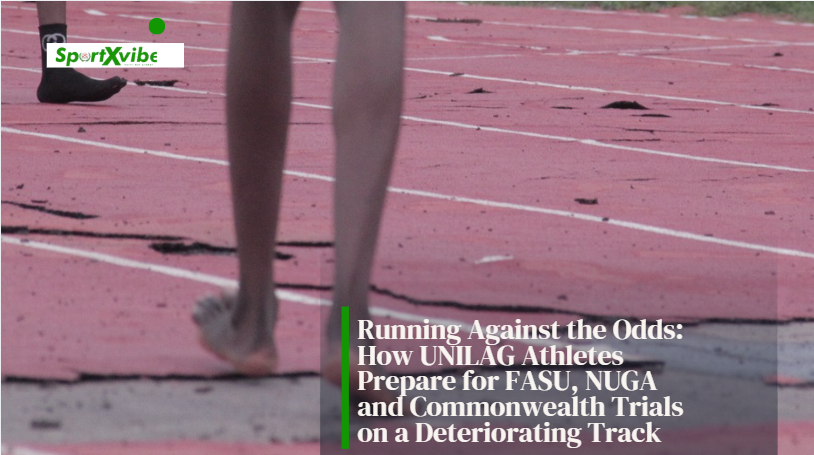
It is a scene that has become routine at the University of Lagos athletics track, popularly known as the Kazanji track, where some of Nigeria’s most promising young sprinters lace up their shoes not on a state-of-the-art surface, but on a distressed tartan that splits, bubbles and shifts under their feet with every stride.
Demilade, a 400-level Electrical Engineering student and competitive sprinter, can’t afford to wait for better conditions. With the Commonwealth Games trials fast approaching, scheduled for June 19-24, he is chasing a personal best of 10.7 or 10.6 seconds in the 100 metres, down from his current 10.8.
“It’s all about discipline,” he says, catching his breath after a training session held in near-darkness and drizzling rain. “Right now, a lot of us are still training despite the facilities, despite the conditions. It’s raining now, it’s dark and the track really isn’t in the best condition. But we keep pushing. We keep training because we know what we want to achieve.”
A track rebuilt for FASU 2024 is failing
The Kazanji track was resurfaced ahead of the Federation of African University Sports (FASU) Games, an investment that should have provided UNILAG athletes with a world-class facility. Instead, within less than a year, the surface began to crack, bubble and peel.
“The material they used was not of high quality,” explains Demilade. “When the rain started to fall, it started to go under the track and the heat caused the rubber to melt and start to break.”
The problem is also structural. The track is located next to the soccer field, and soccer players routinely cross the tartan surface as they move to and from the field, wearing boots that slowly wear away the rubber layer where the most damage is seen today.
“Those areas are where most of the cracks are,” says Joshua Osunlade, another student-athlete who trains at the facility. He describes having to navigate broken sections mid-stride, jumping over concrete edges at the back of the track just to complete a training circuit.
“It’s a little risky,” he admits, “but you just have to do it to get the training.”
Efforts to patch have been made, but they have proven superficial at best. “They tried to patch it several times,” Demilade notes. “But even those patches still appear.”
The cost of leaving campus
For many student-athletes, the instinct to simply train elsewhere hits a hard wall of financial reality.
The Yabatech track, a popular alternative, requires daily transportation costs that most students cannot afford without institutional support. The Surulere National Stadium, although more professionally equipped, costs around ₦1,000 per visit each way. For a student living on the Akoka campus without sponsorship, that is an impossible daily expense.
“It’s not like they’re actually sponsoring your training as a student,” Joshua says plainly. “So it’s not safe. And if there’s no housing there, you have to stay on campus.”
Adebayo Okikiola, another UNILAG athlete known by the nickname FAME, puts it simply: “Even with the bad track and the bad facilities, we can still get something out of it. That’s what makes us great as athletes.”
He says it as a source of pride. But it is also an accusation.
What’s at stake
The calendar ahead of us is not light. UNILAG student-athletes are simultaneously preparing for the Commonwealth Games Trials, FASU, NUGA (Nigerian University Games) and WAIG (West African Inter-University Games), a convergence of competitions that demands maximum physical preparation and optimal training conditions.
“By June we should start the Commonwealth Trials in Yabatech,” says Adebayo, “and we are still going there to perform. Just like I will perform at WAUG, NUGA and FASU. So even with the bad road, we can still get something out of it.”
The solution is not complicated
Those closest to the problem do not ask for the impossible. His prescriptions are well-founded and practical.
First, the track needs proper barricades. Without secure perimeter barriers, the surface remains open to traffic from footballers, spectators and casual pedestrians, all of which contribute to the current damage. “If there are no barricades,” explains Adebayo, “there won’t be people stepping on the track. Anyone can enter.”
Second, a maintenance team needs to be assigned specifically to the track to clean it, monitor it, and address wear and tear before it is damaged.
Third, and most importantly, when resurfacing is finally done, quality materials and properly vetted contractors should be used. The current crisis is, at its core, a procurement failure. A cheap job produced a cheap result.
“I think what they have to do is come and see how we work,” Demilade says, her frustration measured but unmistakable. “Not just on the track, but on the court, on the football field, on the basketball court. Everywhere. They need to get hands-on experience from the athletes. Talk to them, partner with them. So they know what we’re experiencing.”
A call to action
The University of Lagos has produced Olympians, continental champions and national record holders. Its student-athletes don’t simply aspire: they deliver, year after year, on the biggest stages Nigerian university sport has to offer.
They deserve, at the very least, a track that doesn’t put them at risk of injury before they even reach the starting line.
The management of UNILAG, the Students’ Union, the Department of Sports and the relevant facilities committee cannot continue to allow an iconic sports infrastructure to crumble due to negligence. With FASU, NUGA and the Commonwealth Trials on the immediate horizon, the window for taking corrective action is rapidly narrowing.
These athletes are holding up their end of the deal (training in the rain, in the dark, on broken tires) and represent the university with pride in every competition they enter.
It’s time for the university to do its part too.