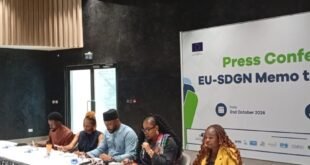
LP crisis deepens as chairman contender Okafor challenges Gov. Otti

The Labour Party (LP) leadership crisis escalated after Callistus Okafor, another candidate for the national chairmanship, denounced a stakeholders meeting convened by Abia State Governor Alex Otti as illegal, unconstitutional and a mere “jamboree.”

Okafor criticized the meeting that led to the appointment of Senator Nenadi Usman as the interim national chairman of the LP, asserting, “We wish to convey to the general public that the so-called jamboree meeting of stakeholders of the Labour Party held in Umuahia, Abia State, is unconstitutional and was not known to any organization of the party.”

He referred to Article 11 of the 2009 Constitution which outlines the party’s organizational structure, and stated, “Article 11 of the 2009 Constitution, which is the only constitution known to the party based on the judgment delivered by the Honorable GO Kolawole on March 20, 2018, explicitly states four party organizations: District, Local Government Area, State and National.”

Also read: Fans to pay N1k, N3k to watch Super Eagles vs Benin in Uyo

Okafor further stated that neither Dr. Alex Otti nor Mr. Peter Obi had the constitutional authority to convene such a meeting, and challenged, “We challenge Otti to produce an official letter addressed to him from the National Electoral Commission (NCC), on this matter.”

He reiterated his commitment to party unity and said, “We are committed to reconciling all members and groups, mobilizing and organizing an inclusive and expansive congress in the districts, local government areas, states and a national convention that will achieve a united and focused Labour Party that will redefine political leadership in Nigeria.”

Post-LP crisis deepens as speaker contender Okafor challenges Gov. Otti first appeared on Latest Nigeria News | Headlines from Ripples Nigeria.

Check Also

Freedom of Information Act and The Limits of Press Freedom, By Mack Ogbamosa – THISAGE

        Introduction  A free, independent, and vibrant press is one of the strongest pillars of any democratic society. It is against this background that most democratic countries  make constitutional provisions for a free press . Others even go further to enact specific laws to make affairs of governments freely available to the public. Currently, there are more than  130 countries in the world that have free press laws. They include Sweden, United States, France, South Africa and Nigeria. Nigeria did not only make  constitutional provisions in Sections 22 and 39(1) of the 1999 Constitution ( as amended) but also went ahead to enact the Freedom of Information Act  in 2011. Section 22 of the 1999  Constitution states: “ “The press, radio, television and other agencies of the mass media  shall at all times be free to uphold the fundamental objectives contained in this chapter( ie Chapter II) and uphold the responsibility and accountability of the Government to the people”  Section 39(1)  of same Constitution states : “Every person shall be entitled to freedom of expression, including freedom to hold opinions and to receive and impart ideas and information without interference” ..  To complement these constitutional provisions, Section 1 (1) of the Freedom of Information Act (FOIA) states “Notwithstanding anything contained in any other Act, law or regulation, the right of any person to access or request information, whether or not contained in any written form, which is in the custody or possession of any public official, agency or institution howsoever described, is established.” while Section  2(2), states that: “A public institution shall ensure the proper organization and maintenance of all information in its custody in a manner that facilitates public access to such information”  Primary Purpose of FOIA  According to the Act, its primary purpose is to make information about public records freely available to every Nigerian in the public interest. …

Leave a Reply

Your email address will not be published. Required fields are marked *