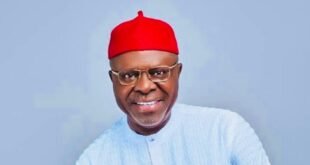
‘Miscarriage of Justice’ – Ighodalo rejected the Supreme Court’s decision in the Edo election

Candidates for the Governor of the Democratic Party (PDP) of the people in the state of Edo, Asue Ighodalo, have rejected the decision of the Supreme Court which confirmed the victory of the Governor of Okpebholo in the September 2024 elections in the state.

Panel five people from the top court led by judge Mohammed Lawal on Thursday rejected the appeal of PDP candidates due to lack of achievements.

The panel argues that Ighodalo and his party failed to determine their claims with the Election and Votes that violate the law during the election.

In a statement issued after the verdict, Ighodalo said he felt a deep sense of betrayal with a top court decision.

He described what was played during the election as “intentional and coordinated robbery.”

He said: “Like you, I feel a deep betrayal. Not only by those who cheated the process, but by the institutions that we believe in protecting our democracy. You are out with hope.

Also read: Head of Ighodalo PDP for the Court’s appeal after the court upholds the victory of Gov Okpebholo

“You choose competence, for progress, for prosperity. And now we are told your voice is not a problem … I feel your pain, I share your anger. And I will never forget your courage.

“We are not people who are afraid or not destroyed. We might be injured. But all the wounds healed. So let this be our oath. We will not retreat. We will not be silenced. And we will not forget.”

“Even though I received the final of the Supreme Court’s decision, I did not and could not pretend that what was conveyed was the same as justice.”


Check Also

Freedom of Information Act and The Limits of Press Freedom, By Mack Ogbamosa – THISAGE

        Introduction  A free, independent, and vibrant press is one of the strongest pillars of any democratic society. It is against this background that most democratic countries  make constitutional provisions for a free press . Others even go further to enact specific laws to make affairs of governments freely available to the public. Currently, there are more than  130 countries in the world that have free press laws. They include Sweden, United States, France, South Africa and Nigeria. Nigeria did not only make  constitutional provisions in Sections 22 and 39(1) of the 1999 Constitution ( as amended) but also went ahead to enact the Freedom of Information Act  in 2011. Section 22 of the 1999  Constitution states: “ “The press, radio, television and other agencies of the mass media  shall at all times be free to uphold the fundamental objectives contained in this chapter( ie Chapter II) and uphold the responsibility and accountability of the Government to the people”  Section 39(1)  of same Constitution states : “Every person shall be entitled to freedom of expression, including freedom to hold opinions and to receive and impart ideas and information without interference” ..  To complement these constitutional provisions, Section 1 (1) of the Freedom of Information Act (FOIA) states “Notwithstanding anything contained in any other Act, law or regulation, the right of any person to access or request information, whether or not contained in any written form, which is in the custody or possession of any public official, agency or institution howsoever described, is established.” while Section  2(2), states that: “A public institution shall ensure the proper organization and maintenance of all information in its custody in a manner that facilitates public access to such information”  Primary Purpose of FOIA  According to the Act, its primary purpose is to make information about public records freely available to every Nigerian in the public interest. …

Leave a Reply

Your email address will not be published. Required fields are marked *