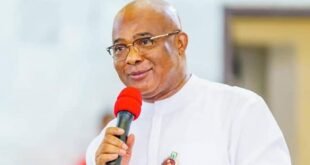
Wike said the opposition ‘Coalition was born and died on the same day’

Minister of FCT Nysom Wike doubted the feasibility of the many opposition coalitions discussed led by Atiku Abubakar, Peter Obi, and Nasir El-Rufai, stated it “was born and died on the same day.”

Speaking to the inauguration of the left hand service path in Abuja on Friday, Wike urged residents to reject the promises of political figures whose names might never even appear in the voting.

“Until now, they have not settled between themselves … Is it a left or right coalition? The coalition that was born and died on the same day,” Wike said.

Jibe echoed the previous statement by the President of Bola Tinubu during his speech Democracy Day, where he refused concerns about a Nigerian party but expressed confidence in the internal opposition division.

Wike continued his criticism, accusing the opposition of sending messages and fake promises:

“Abuja people … you let people come and deceive you and tell you lies … and you pay attention to those you don’t know whether their names will be in ballots or not.”

This event also attracted PDP figures such as former Governor Ifeiri Uguuanyi (Enugu) and Ayo Fayose (Ekiti), describing the political cross in the Abuja rulers, amidst the defense of the PDP Governor to APC and continued tensions in the Labor Party and PDP ranking.


Check Also

Freedom of Information Act and The Limits of Press Freedom, By Mack Ogbamosa – THISAGE

        Introduction  A free, independent, and vibrant press is one of the strongest pillars of any democratic society. It is against this background that most democratic countries  make constitutional provisions for a free press . Others even go further to enact specific laws to make affairs of governments freely available to the public. Currently, there are more than  130 countries in the world that have free press laws. They include Sweden, United States, France, South Africa and Nigeria. Nigeria did not only make  constitutional provisions in Sections 22 and 39(1) of the 1999 Constitution ( as amended) but also went ahead to enact the Freedom of Information Act  in 2011. Section 22 of the 1999  Constitution states: “ “The press, radio, television and other agencies of the mass media  shall at all times be free to uphold the fundamental objectives contained in this chapter( ie Chapter II) and uphold the responsibility and accountability of the Government to the people”  Section 39(1)  of same Constitution states : “Every person shall be entitled to freedom of expression, including freedom to hold opinions and to receive and impart ideas and information without interference” ..  To complement these constitutional provisions, Section 1 (1) of the Freedom of Information Act (FOIA) states “Notwithstanding anything contained in any other Act, law or regulation, the right of any person to access or request information, whether or not contained in any written form, which is in the custody or possession of any public official, agency or institution howsoever described, is established.” while Section  2(2), states that: “A public institution shall ensure the proper organization and maintenance of all information in its custody in a manner that facilitates public access to such information”  Primary Purpose of FOIA  According to the Act, its primary purpose is to make information about public records freely available to every Nigerian in the public interest. …

Leave a Reply

Your email address will not be published. Required fields are marked *