JamzNG Latest News, Gist, Entertainment in Nigeria
At a time when few people were willing to risk the wrath of the US president, Spain was a different country.
For several days after the start of the US-Israel attack Iranthe country felt like the only EU voice questioning the legality of the operation.
Iran latest: Iran is close to electing a new leader
Then they went further, refusing to let on American use Spanish base to launch military operations.
Donald Trump responded to this action by threatening Spain with a trade war.
“We will cut off all trade with Spain. We don’t want anything to do with Spain,” he said, flanked by silent crowds. Chancellor of Germany.
But Spain did not budge. Today, Prime Minister Pedro Sanchez addressed the nation, summing up his position in four words, “no to war.”
He said this stance was in no way a sign of support for Ayotollah; instead, he called on Iran, Israel and the United States to stop the fighting before it was too late.
“Twenty-three years ago, another US administration dragged us into war with the Middle East. This sparked the greatest wave of insecurity our continent has experienced since the fall of the Berlin Wall,” Sanchez said.
He also warned that the war risks “playing Russian roulette” with millions of lives.
Clearly unafraid to challenge the US president further, he said government is meant to improve people’s lives and provide solutions to problems, not make them worse. He added: “It is unacceptable that leaders who are incapable of fulfilling their duties try to cover their failures with the smoke of war.”
Ouch!
👉 Follow Trump100 on your podcast app 👈
Trump is not used to being openly challenged. As I write this, we’re still waiting for his reaction to this morning’s speech, but it seems unlikely he’ll let it slide.
Others have already reacted, such as Spain’s Vice President of the European Commission, Teresa Ribera, who supported her country, condemning Trump’s threat as detrimental to global stability.
“Tensions arise from the way of dealing with third parties, be it the British Prime Minister Keir StarmerPresident of France Emmanuel Macronor Pedro Sanchez, really disrupts society, peace, cooperation and also the economy,” he said.
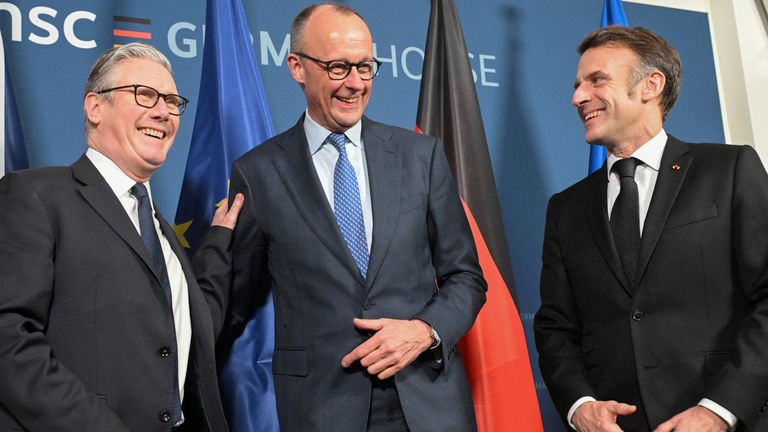
Sir Keir Starmer, Friedrich Merz and Emmanuel Macron are trying to resolve the tense situation with Donald Trump. File photo: Reuters
Meanwhile, sources in France and Spain tell us that the French president plans to call Sanchez to show his loyalty.
In a softer tone last night, Emmanuel Macron joined the Spanish prime minister in questioning the legality of the attack, concluding that it was carried out “outside international law” and that Paris “cannot approve of it”.
But what about Germany, the largest country in the European Union?
Although Friedrich Merz disagreed with Trump in his criticism of Spain’s stance towards Iran, the German chancellor certainly did not immediately defend Spain.
In fact, he later mentioned that they were still negotiating with Madrid to increase their contribution to NATO – another issue for the US president.
Read more from Sky News:
Will Iran ‘day-to-day’ be free of atomic weapons?
US allies fear weapons shortages
Does AI give the US a lethal edge in Iran?
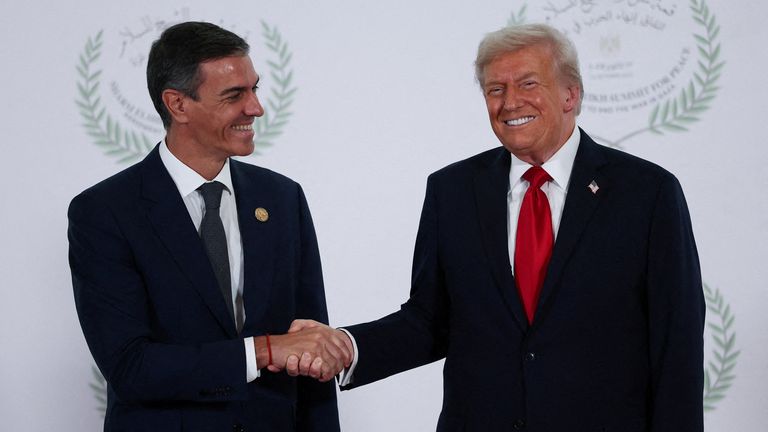
Donald Trump and Pedro Sanchez exchange warm greetings in October 2025. Photo: Reuters
When asked by journalists about this, the chancellor said he discussed the attacks on Spain and the UK personally, reminding Donald Trump that Spain is a member of the EU, so it cannot be ignored.
“I don’t want to escalate or prolong the debate in public,” explained Merz.
While the reasoning – that an open challenge to Trump would likely only make the situation worse – makes sense in light of that Zelenskyy’s experience last yearthe Spanish were not impressed.
Spain’s foreign minister expressed his “surprise” at the chancellor’s behavior, firmly saying: “I cannot imagine Chancellor (Angela) Merkel or (Olaf) Scholz making such statements.”
While other Spanish sources went further, saying: “Merz has an attitude unbecoming of a European leader who defends the unity of his partners.”
It seems that by deciding not to oppose Donald Trump, Friedrich Merz has put himself on the right track to attack Madrid.