JamzNG Latest News, Gist, Entertainment in Nigeria
The federal government has announced the expansion of the national rail network.
This involved the development of a smart national transport database, standardized bus terminals and plans for high-speed rail connectivity across the country.
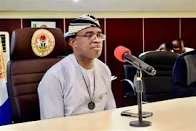
The Permanent Secretary of the Ministry of Transport, Engr Olufunso Adebiyi, disclosed this on Monday at the opening of the 19th National Transport Council.
He said the Federal Government was moving away from Nigeria’s over-dependence on road transport by strengthening rail, water and air transport infrastructure.
Speaking on the council’s theme, “Developing an Effective Transport System for Nigeria: The Role of Integrated Transport”, Adebiyi said transport remains central to Nigeria’s economic development.
He noted that the movement of people, goods and services is essential for trade, employment, productivity and national growth.
He listed several completed and operational rail corridors, including Port Harcourt–Aba, Warri–Itakpe, Lagos–Ibadan and Abuja–Kaduna, revealing that work was progressing on additional routes.
According to him, the Kaduna-Zaria-Kano corridor is nearing completion and is expected to become operational by December, while the Kaduna-Daura-Katsina axis is also moving towards completion.
He added that the Katsina-Jibia-Maradi link is expected to be ready by next year, while work on the Kano-Dutse corridor is also progressing.
The Permanent Secretary said the government’s rail strategy is not just about passenger movement, but also about reducing the enormous pressure placed on Nigeria’s roads by heavy vehicles and cargo.
He explained that shifting cargo from trucks to rail would reduce road congestion, accidents and pressure on road pavements, while extending the lifespan of critical road infrastructure.
He said the federal government was also looking to extend the movement of goods from Ibadan to other parts of the country, with dry ports providing points where containers could be transferred closer to their destinations.
Another major achievement highlighted by the Permanent Secretary was the Federal Executive Council’s approval of the National Transport Intelligent Database under a Design-Build-Finance-Operate-and-Transfer Agreement.
Adebiyi said the project would address one of the major weaknesses of Nigeria’s transportation system: the absence of a comprehensive and reliable database.
He said the initiative would also strengthen road safety and enforcement by enabling vehicles and operators to be tracked through integrated digital logs.
According to him, standardized posters will be introduced in car parks, which collect essential information about vehicles, drivers, passengers and their destinations.
“This simply means that whenever a vehicle has an accident anywhere, you can pick the passenger list and know who is on board and for what purpose,” he said.
He also said that vehicle license plate numbers will be increasingly computerized, making it easier for authorities to identify motorists who violate traffic rules.
The Federal Government has also approved the development of standardized bus terminals across Nigeria, starting with six terminals, Adebiyi announced.
It said the terminals will operate to uniform minimum standards and will include waiting areas, passenger information systems, police posts, vehicle inspection and mechanical facilities, restaurants, toilets and other services.
He added that transport operators will be required to meet regulatory and safety standards before they can operate.
He stressed that he will also be subject to sanctions if operators violate the established rules.
In another ambitious plan, Adebiyi announced that the government is working on plans for a high-speed rail system that will connect Lagos to Maiduguri, with trains potentially capable of operating at speeds of up to 360 kilometers per hour.
He said the project would radically reduce travel time between major Nigerian cities and provide Nigerians with a viable alternative to road transport.
Adebiyi said the government’s ultimate goal is to give Nigerians the freedom to choose between road, rail, air and sea transport rather than forcing citizens to depend almost entirely on roads.
He also revealed that government has approved light rail projects for selected cities, including Kano and Lagos, as part of measures to ease urban congestion and reduce pressure on road infrastructure.
He said similar projects will be expanded to other state capitals as part of the broader strategy to develop an integrated national transportation network.
On maritime transport, Adebiyi said major interventions were also underway in Nigeria’s ports, including reconstruction and automation.
He said the ongoing works will improve cargo handling and make port operations faster, safer, more efficient and economical.
According to him, the reforms should significantly reduce port congestion and improve the movement of goods throughout the country.
In his speech, the Head of Civil Service of the Federation, Abel Enitan, said Nigeria must complement infrastructure development with strong institutions, effective regulation, reliable data, innovation and a skilled workforce.
Enitan described transport as the “lifeblood of the modern economy”, saying an efficient transport system would improve access to markets, support trade and investment, reduce logistics costs and improve the competitiveness of Nigerian businesses.
He called for greater coordination between federal and state governments and stronger collaboration among transportation agencies.
The service chief also urged council participants to focus on practical outcomes.
He stressed that the success of the meeting should ultimately be measured by the extent to which its resolutions translate into policies, programs and reforms that bring tangible improvements to Nigerians.