JamzNG Latest News, Gist, Entertainment in Nigeria
About 1.5 million people, or about 12 percent of the population, were forced to leave their homes.
Haiti does not produce its own weapons or ammunition, but the gangs never seem to run out.
On Wednesday, the U.N Security Council The new sanctions are intended to change that by targeting people deemed responsible for or involved in activities that threaten Haiti’s peace, security and stability.
What are the sanctions?
Created in 2022 by the Security Council, Haiti Sanctions Committee has three main enforcement tools: arms embargo, travel ban, and asset freeze.
The embargo targets weapons and ammunition that reach armed groups. Travel bans and freezes apply to people and entities contributing to insecurity and gang violence in the Caribbean island nation.
Nine individuals and two groups are currently sanctioned by the board.
Why are they needed?
The costs of gang violence in Haiti are enormous.
More than 3,000 people were killed and more than 1,500 injured between October last year and April this year.
A house in the Cité Soleil neighborhood of Port-au-Prince was destroyed after being set on fire by gang members.
A UN partner reported treating more than 2,400 survivors of sexual violence in Port-au-Prince between January and May. Most are women and girls and 16 percent are minors. Cases involving children as young as eight were also reported.
Children are also recruited by gangs.
How are sanctions enforced?
Most of this is done by governments, at ports, borders and banks.
Haitian authorities have recently intercepted several illegal shipments at the port.
United States authorities have also intercepted firearms and ammunition destined for Haiti and launched a human trafficking investigation.
United Nations Office on Drugs and Crime (UNODC) supports regional efforts to combat human trafficking.
Does this work?
Haiti does not produce firearms or ammunition, but complies number released by the UN human rights office last year, there were estimated to be between 270,000 and 500,000 illegal weapons in circulation.
The arms embargo is violated “regularly” according to expert panel in Haiti, an independent fact-finding body established by the Security Council, which collects evidence and analyzes information regarding sanctions violations.
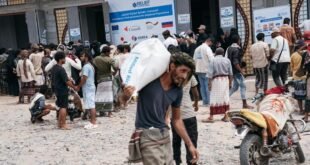
People queue for help in Port-au-Prince.
These independent experts have traveled to Port-au-Prince and Cap-Haïtien in Haiti, Santo Domingo in the neighboring Dominican Republic, and Miami in the US to meet with government officials, police, financial institutions, civil society representatives, and people affected by gang violence.
Some of the bullets in the gang’s possession came from a national stockpile, and police did not centrally track what they confiscated, so some weapons went unnoticed or were diverted by corrupt officers.
The asset freeze got worse, the panel said. Only two accounts of sanctioned individuals were reportedly frozen, a small amount, because banks acted slowly and targets moved money or hid it in the name of third parties.
The panel found no attempt to violate the travel ban, but warned that fake passports could help sanctioned people travel under false names.
What do the experts say?
The message from the independent panel was that “targeting gang leaders without addressing the networks that support them is doomed to failure.”
The report points to political, economic and security figures who support the gangs and says that many gang leaders outside the sanctions list meet the criteria.
What happened next?
These gangs continue their deadly expansion despite sanctions, a clear indication that law enforcement is critical.
The UN Security Council meets to discuss Haiti and renew sanctions.
At Wednesday’s meeting, speakers from some of the 15 Member States of the Security Council reiterates the need to stop gang funding, close loopholes and hold accountable networks that support armed groups.
The council extended the work of the sanctions committee by 13 months.
Haiti welcomed the update while warning that sanctions alone could not restore security.
For Haitians living with gang violence, what matters is whether the work of the sanctions committee and efforts undertaken by the Government of Haiti and countries in the region can result in a safer environment, fewer guns in the hands of criminals, and greater freedom to travel, work, and reach essential services.