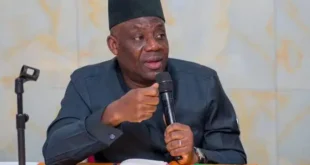
Benue Governor Alia fires election commission chairman over poor assessment

Governor Hyacinth Alia has approved the removal of Dr John Chem as chairman of the State Independent Electoral Commission (SIEC), following a recommendation from the state House of Representatives.

Lawmakers accused Chem of poor judgment, saying his decision failed to appeal to the majority of stakeholders and did not take into account the public interest.

In a statement issued Friday by the governor’s Chief Press Secretary, Kula Tersoo, Alia received the assembly’s resolution and ordered Chem to submit it to the commission’s administrative secretary immediately.

Read Also: Nigerian Defense Chief warns military will intervene if violent protests continue

The statement read, “The Assembly accuses the BSIEC Chairman of lacking sound judgment on which decisions would be in the interests of the majority of all stakeholders, and also that his actions so far in office do not reflect the public interest.

“Governor Alia has accepted the decision and ordered the Chairman of the commission to immediately submit it to the administrative secretary of the commission.”

The move comes amid concerns over the commission’s handling of election issues in the state. The governor’s decision is seen as an effort to restore public trust and ensure the integrity of the election process.

Benue Governor Alia sacks electoral commission chairman over bad decisions first appeared on Latest Nigeria News | Headlines from Ripples Nigeria.


Check Also

Freedom of Information Act and The Limits of Press Freedom, By Mack Ogbamosa – THISAGE

        Introduction  A free, independent, and vibrant press is one of the strongest pillars of any democratic society. It is against this background that most democratic countries  make constitutional provisions for a free press . Others even go further to enact specific laws to make affairs of governments freely available to the public. Currently, there are more than  130 countries in the world that have free press laws. They include Sweden, United States, France, South Africa and Nigeria. Nigeria did not only make  constitutional provisions in Sections 22 and 39(1) of the 1999 Constitution ( as amended) but also went ahead to enact the Freedom of Information Act  in 2011. Section 22 of the 1999  Constitution states: “ “The press, radio, television and other agencies of the mass media  shall at all times be free to uphold the fundamental objectives contained in this chapter( ie Chapter II) and uphold the responsibility and accountability of the Government to the people”  Section 39(1)  of same Constitution states : “Every person shall be entitled to freedom of expression, including freedom to hold opinions and to receive and impart ideas and information without interference” ..  To complement these constitutional provisions, Section 1 (1) of the Freedom of Information Act (FOIA) states “Notwithstanding anything contained in any other Act, law or regulation, the right of any person to access or request information, whether or not contained in any written form, which is in the custody or possession of any public official, agency or institution howsoever described, is established.” while Section  2(2), states that: “A public institution shall ensure the proper organization and maintenance of all information in its custody in a manner that facilitates public access to such information”  Primary Purpose of FOIA  According to the Act, its primary purpose is to make information about public records freely available to every Nigerian in the public interest. …

Leave a Reply

Your email address will not be published. Required fields are marked *