JamzNG Latest News, Gist, Entertainment in Nigeria
Nigeria will end its 11-year partnership with Nike and return to Adidas, after agreeing an equipment deal worth $8.5 million a year which the Nigerian Football Federation (NFF) says is the largest in African football.
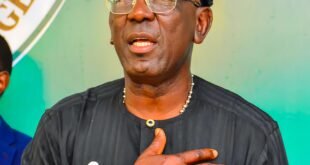
According to ESPN, former NFF president Ibrahim Gusau, who resigned along with the federation’s executive committee on Thursday, revealed the deal at a press conference in Abuja.
Gusau said Adidas will pay the NFF $4.5 million each year and another $4 million in equipment for Nigeria’s national teams.
Additionally, the NFF will earn a 20% royalty on merchandise sales, which could raise the value of the deal well beyond the guaranteed $8.5 million annually.
Gusau revealed that the contract has already been signed, but was originally scheduled to be announced in September.
“This is the biggest kit sponsorship in Africa. No other country in Africa has that kind of sponsorship,” Gusau told reporters in Abuja.
“Adidas will pay Nigeria $4.5 million each year in cash and then provide it with equipment worth $4 million each year.”
Nigeria’s new deal also represents a substantial increase in its outgoing contract with Nike, which Gusau said had become inadequate to meet the federation’s national team requirements.
“As [then] President, I can’t give someone a t-shirt because we fulfilled a contract that has been in place for 11 years on the same terms worth $500,000 in cash and $1 million in uniform supplies.
“$500,000 in 2015 and still $500,000 in 2026. It’s like you have nothing.”
Gusau said the limitations of the existing agreement had become so severe that the federation was purchasing additional equipment for its teams, including Nigeria’s under-20 women’s team for the World Cup in Poland.
“We have to buy t-shirts for the girls who traveled to Poland because a million dollars worth of equipment cannot even be used for the Super Eagles’ qualifiers for the World Cup and the Nations Cup, as well as for the Super Falcons,” he said.
Gusau said the shortcomings of that agreement led the federation to begin negotiations with Nike in 2024 to improve conditions.
“This was unacceptable to us as a country and we looked and found that even countries that didn’t have our profile in football had better offers,” he said.
“These smaller countries, with less visibility than us, had better deals. So we approached Nike to get an improved contract. This process started in 2024, going back and forth with them, but we couldn’t reach an agreement because we couldn’t accept what they were offering.”
Gusau pointed to adidas’ increased retail presence in Nigeria as another reason for making the move and said the company’s planned expansion could boost the NFF’s revenue from its 20% royalty on sales.
“Nike has only one store in Nigeria. It is in Lagos. Adidas has about 13 stores, so they are visible everywhere,” he said.
Gusau said the additional revenue would also give the NFF greater flexibility in recruiting coaches for its senior national teams, an area where finances have repeatedly limited the federation’s options.
“The issue of people clamoring for a high-profile coach for the Super Eagles or Super Falcons that we were running away from because we were wondering how we would pay, will be a thing of the past in the future,” he said.
“The money will be enough for the NFF to hire high-profile coaches for the Super Eagles and Super Falcons.”
Morocco’s current deal with Puma is the highest figure publicly known and is reportedly valued at $1.7 million.
Adidas provided Nigeria to the country’s 1994 African Cup of Nations triumph and its first World Cup appearance that same year, before Nike took over in 1995.
Nigeria returned to Adidas in 2004 and remained with the German company until 2014, a period that included the Super Eagles’ 2013 African Cup of Nations title.
Nike’s return in 2015 produced some of Nigeria’s most recognizable kits, notably the Super Eagles jersey for the 2018 World Cup, which became an international fashion and commercial success.