JamzNG Latest News, Gist, Entertainment in Nigeria
Post views: 9
By Osondu Ohaeri
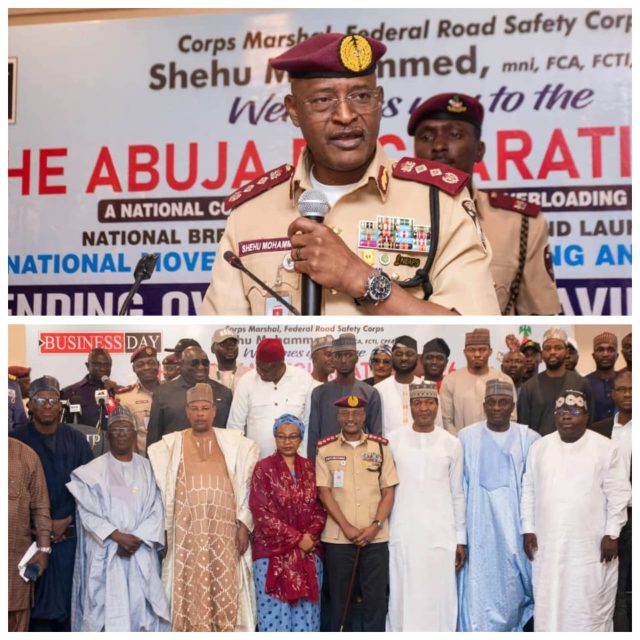
The recent national dialogue convened by the Federal Road Safety Corps in Abuja on the dangers of vehicle overloading represents a major shift from viewing overloading and mixed loading simply as traffic offenses to addressing it as a national concern for road safety, infrastructure, the economy and public health.
The dialogue, which reportedly took place in conjunction with the launch of the National Safe Loading and Safe Streets Movement, brought renewed attention to the need for collective action by vehicle owners, drivers, fleet operators, cargo owners, loading agents, regulators and government.
Overloading is more than a traffic violation
The central issue emerging from the dialogue is that overloading has consequences that extend far beyond the vehicle immediately involved.
Excessive loads can compromise a vehicle’s braking efficiency, steering, stability and handling, while increasing mechanical stress and the likelihood of an accident. The 2012 National Road Traffic Regulations specifically prohibit driving a vehicle with a load exceeding the manufacturer’s specifications or gross vehicle weight. Regulation 188 also authorizes authorized officers to request the removal of excess loads before the vehicle proceeds.
The Corps’ current offenses program also identifies overloading as a traffic offense carrying penalty points and a prescribed fine.
The human cost must remain the primary concern
At the heart of the dialogue should be a fundamental question: how many lives are needlessly exposed to risk due to unsafe loading practices?
According to FRSC, data reported in October 2025 indicated that 3,433 people were killed and 22,162 injured in 6,858 traffic crashes reported between January and September 2025. Likewise, the Corps identified driver fatigue, overloading people, and carrying people in transport vehicles as major crash-related concerns, among other factors. This places overloading within the broader challenge of changing the unsafe behavior of road users.
The economic argument for overloading needs to be reconsidered.
One of the strongest themes in the national debate is the perception of some operators that carrying additional passengers or cargo reduces transportation costs and increases profits.
The dialogue provided an opportunity to challenge this illusory calculation.
The apparent economic benefit of carrying an excessive load may be offset by: increased fuel consumption; accelerated deterioration of the vehicle; tire and brake failures; damage to road infrastructure;
delays caused by breakdowns and accidents; load loss; medical and emergency response costs; loss of human productive capacity; AND
compensation and insurance costs.
Consequently, secure cargo should be presented not as an obstacle to transport and trade, but as an investment in sustainable mobility and economic productivity.
Road infrastructure is also a victim
Overloading doesn’t just affect vehicles and humans. Excessive loads on axles and vehicles can contribute to accelerating the deterioration of road infrastructure.
This makes the issue particularly significant for Nigeria, where the government invests significant resources in the construction, rehabilitation and maintenance of highways. A safer loading regime therefore has a double benefit: protecting road users and protecting public infrastructure.
Responsibility must go beyond the driver
A particularly important dimension of the national dialogue is the recognition that the driver should not be the only person held responsible for an unsafe load. The entire logistics chain plays a role:
Cargo owner → shipper → loading agent → transporter/fleet operator → driver → regulator.
Owners of goods should accurately declare the weight of shipments. Loading agents must respect the prescribed limits. Fleet operators should maintain vehicles properly. Drivers should refuse dangerous or improperly secured loads, while regulatory agencies should provide effective monitoring and enforcement. This approach shifts the conversation from individual blame to shared responsibility.
The application alone cannot solve the problem
The FRSC’s mandate combines enforcement with public information, stakeholder cooperation, data management, vehicle administration, emergency response and patrol operations. As a result, the response to overload requires a combination of: sustained public education; effective weighing and load evaluation; compliance with the prescribed weight limits; appropriate sanctions; stronger fleet management systems; driver education and professional training; involvement of trade unions and transport operators; better cargo loading practices; better road and vehicle data; and continuous dialogue with interested parties. The message should be clear: enforcement is a deterrent, but education and stakeholder ownership produces sustainable behavioral change.
The Abuja Declaration should translate dialogue into measurable action. An important test of the dialogue will be what happens after the participants leave Abuja.
The call for stakeholders to adopt an Abuja Declaration 2026 offers an opportunity to move from discussion to measurable commitments. For the Federal Road Safety Corps, which convened the national conversation, there are stronger indications that the dialogue was deliberately designed and organized to trigger the usual safety awareness campaigns from December to September, anchored on the dangers of overloading and subsequently, in line with other traffic vices such as violating speed limits, using the phone while driving, route violation and other traffic-related violations.
Building on the outcomes of the dialogue, the Corps seeks to sustain momentum by adopting overloading as the main thrust for its many public and advocacy campaigns during the Ember season, as well as advocating for a stronger framework and commitment from key stakeholders to end overloading and mixed loading in Nigeria.
Such a framework would be very useful if it contained clearly defined responsibilities, timelines, indicators and mechanisms to monitor implementation. For example: Commitment → Responsible Stakeholder → Timeline → Performance Indicator → Monitoring Mechanism.
This would make the national movement more than an awareness campaign; it could become a practical framework for reducing unsafe loads nationwide.
The media plays an important role
As critical players in changing public behavior, the media should help change the public narrative about overload. Instead of reporting overloading only when it causes a fatality, the media can adopt this proactive narrative: What is overloading? Why is it dangerous? Who is responsible? What does the law say? What should motorists do? Where can violations be reported?
Human interest stories, investigative reports, radio debates, documentaries, infographics and social media campaigns can make the consequences of overcharging understandable to both commercial operators and ordinary motorists.
Towards a safer automotive environment
The broader significance of the Abuja dialogue is that a safer automotive environment cannot be created by the FRSC alone.
It requires a road safety ecosystem in which government agencies, transport operators, manufacturers, road users, load owners, media, civil society and other stakeholders recognize that every unsafe decision on the road can impose consequences on someone else.
As the leading national road safety management and traffic administration agency, the FRSC itself defines its vision as eliminating road accidents and creating a safe automotive environment in Nigeria.
The national dialogue therefore offers the opportunity to deepen the country’s road safety culture, making safe loading a shared national responsibility rather than simply a matter of enforcement.
The Abuja Dialogue brought an important road safety issue back to national consciousness: a vehicle should never carry more than it was designed, licensed and safely configured to carry.
The true measure of the initiative, however, will not be the number of speeches given or participants gathered. This will result in safer loading practices, increased compliance, fewer overloaded vehicles, fewer accidents, better protected roads and, ultimately, saved lives.
The Abuja message should therefore resonate throughout Nigeria:
Charge safely. Drive responsibly. Protect the road. Protect lives.
Osondu Ohaeri is the Education Corps Officer at the FRSC National Headquarters in Abuja and a Fellow of the Nigerian Institute of Public Relations