JamzNG Latest News, Gist, Entertainment in Nigeria
Peace must be sewn, stitch by stitch.
With this in mind, Ms. Avella decided to work in a small sewing workshop in Catatumbo, Colombia, one of the outcomes of the 2016 peace agreement between the Colombian Government and FARC rebels, designed to help reintegrate former combatants, and heal the wounds of conflict.
Like many former combatants, she was looking for a way to rebuild her life after the war, and this workshop serves as a space for training, care and empowerment for women that will contribute to preventing gender-based violence – a place where they can learn skills, support each other and regain self-confidence amidst a region marked by violence.
Together with several other women, Ms. Avella founded Stitches for Peace, which began making t-shirts, T-shirts and uniforms. But in 2021, the project took an unexpected turn towards high fashion.
At an initiative led by the UN Verification Mission in Colombia, he met Lina Garcés, an economist graduated from the University of Externado and founder of a second-hand clothing boutique called Lina’s Closet, in Cúcuta.
Ms. Garcés often says that her shop sells “second chance clothing,” a phrase that will soon take on a new meaning.
Ms. Garcés agreed to participate, although not without conditions. His personal history is marked by armed conflict, and his family was once a victim of kidnapping, leaving painful memories.
However, he decided to travel to Caño Indio, in the middle of the Catatumbo jungle, where he discovered a place very different from the fashion world where he worked: prefabricated accommodation, tin roofs, unpaved roads and public bathrooms.
But he also discovered something he didn’t expect: talent. “The women had impressive abilities,” he recalled. “The person who sews does so with extraordinary precision; the person who cuts has a professional nature.” Many had learned to use a needle and thread during the war, repairing uniforms or boots. Now that knowledge weaves another story.
Katerine Avella and Lina Garcés celebrate the creation of the Ixora brand skirt.
Ixora skirt and reconciliation
For fifteen days they worked intensively on design, sizing and finishing. From that time, the idea was born to create a wraparound skirt with a motif inspired by the Ixora flower, a plant that blooms all year round and symbolizes resilience and perseverance in Catatumbo.
As a result of all these workshops, the brand ‘Ixora, inclusive and autonomous’ was born. At the end of 2021, they already had their first collection which they presented at the Julio Pérez library in Cúcuta. The parade brought together conflict victims and peace signatories on the same catwalk.
Some time later, in a discussion at the Cúcuta Book Fair, where they were invited to tell their stories, Mrs. Garcés told her family history for the first time in public. As she spoke, Ms. Avella listened to him silently. Ms. Garcés told the audience: “For me, right now they are sensitive women, who want to move forward. For me, there is forgiveness; now I want to support them and make more people aware of their work so that we can live in peace.”
The skirt began to be sold through Ms. Garcés and soon other designers became interested in this initiative. Ixora began appearing at fashion shows in Tibú, Ocaña and Bogotá, and in 2022 they arrived for the first time at Colombiamoda, the most important textile fair in the country. They did it again in 2023 and 2024, as special guests, on the catwalk.
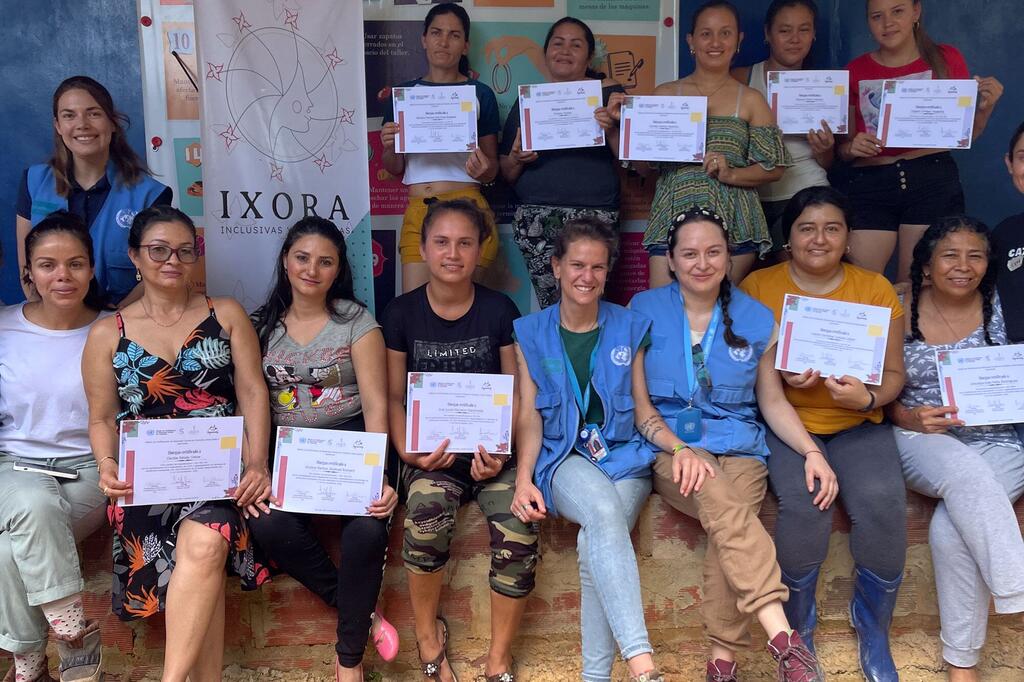
Women from the Ixora brand at the trade show after the end of the garment making workshop organized by UNVMC
Violence occurred again
However, this story of reconciliation, entrepreneurship and peace was seriously affected in January last year, when violence again escalated in the region. There was mass displacement, the killing of social leaders and former guerrillas, and thousands of families were forced to flee their homes.
Sewing workshops must be closed. “The women didn’t want to come back because they were afraid,” Avella recalled. At that time, the priority was to protect life.
Paradoxically, in the midst of the crisis came the news they had been waiting for months: Ixora had been officially registered as a trademark in Colombia by the Inspectorate of Industry and Commerce. But they decided not to celebrate. “This is not the time,” said Ms. Avella. “Too much uncertainty.”
Currently the project is on forced pause. The sewing machine is still in Caño Indio, while the women wait for guarantees to be able to move to a new, safer place in rural Cúcuta.
Hope for the future
Even so, Ixora’s story is not over. The brand recently won a project with the Agency for Reincorporation and Normalization (ARN) to accompany other women in the process of self-care and psychological support. This is a new stage for Ixora, which now seeks to not only generate income, but also offer a space of well-being for those living under the impact of conflict.
“This project is a dream,” Ms. Avella said calmly. “Beyond the economic side, this means keeping our association alive and showing that we can build something different.”
Meanwhile, the women waited for the moment to restart the machine. In Catatumbo, where many stories end abruptly, Like the flower from which it gets its name, there is hope that Ixora will bloom again, even in the most difficult conditions.