JamzNG Latest News, Gist, Entertainment in Nigeria
*Says Nigerians need deliveries, not another ‘animal farm’ promise, in President’s GNC plan
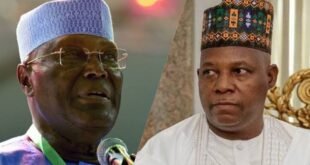
Nigeria’s former vice president and African Democratic Congress (ADC) presidential candidate, Atiku Abubakar, has said his targeted subsidy plan would ensure the production of cheaper fuel and, as a result, lead to cheaper transport fares.
President Bola Tinubu, in a statement on Thursday, said that because “cheaper fuel must mean cheaper transport fares,” he had reached an agreement with state governors to “cut transport fares nationwide” by leveraging CNG and electric vehicles.
But Atiku, in a statement from his press office on Friday, criticized Tinubu’s proposal, describing it as another “Animal Farm” promise.
He insisted that the proposed innovative subsidy would not only ensure the production of cheaper fuel but also reduce transport and food costs. It would also, he said, support Nigerian manufacturing, protect consumers and put more purchasing power in the hands of Nigerians.
In contrast, the ADC presidential candidate said Tinubu’s plan to partner with state governors by leveraging CNG and electric vehicles raises more questions than answers.
He asked: Is the government announcing a fully operational program or simply announcing a target for a program whose implementation framework is still under development?
He noted that while President Tinubu said the Federal Government and state governors have agreed to begin implementing measures to reduce transportation fares, with the aim of Nigerians benefiting from lower fares from October 1, the Nigeria Governors Forum, in its communiqué following its meeting on August 26, said the proposed National Affordable CNG Transit Program still requires further consideration of its financial and implementation framework.
Governor Douye Diri also indicated that the implementation timetable will be agreed with stakeholders.
“This means Nigerians deserve clarity. What exactly will be operational on October 1?” he asked.
“The government says more than 120,000 vehicles have already been converted to CNG and that further conversion kits are being rolled out. But Nigerians need more than a headline figure.
“It is worth knowing how many of these vehicles are commercial passenger vehicles. How many currently operate on CNG every day? How many passengers actually benefit from reduced fares?”
“And in which states and on which routes? These are the numbers that matter.”
The Waziri Adamawa stressed that “an announced, ordered or planned station is not the same as a station that is operational, stocked and accessible to commercial transport operators”.
According to him, the Tinubu-led APC government should therefore publish the location, status and commissioning timetable of these stations.
Most important, he said, is the need for a transparent system to ensure savings reach commuters.
“If the government supports vehicle conversion, provides financing, supplies fleets or subsidizes infrastructure, participating operators should have clearly defined tariff obligations.
“There should be: a published basic fare; a published reduced fare; identified routes and participating operators; transparent details of government support; a clear implementation timetable; and an enforcement mechanism for operators who receive public support but fail to pass the savings on to passengers.”
The former Vice President noted that the Tinubu government’s previous experience in the CNG sector shows that enforcement is important.
He recalled that in 2025, the Federal Government announced a 40% tariff reduction on CNG-served routes in Abuja and deployed a task force to monitor compliance. However, reports at the time also highlighted issues relating to the availability of methane and the ability of converted vehicles to access adequate supplies.
“The lesson is clear: a fare reduction announced in Abuja is not the same as a nationwide transport solution.
“Nigeria is a large country with very different transportation systems and levels of CNG infrastructure.
“A commuter in Lagos, Abuja or another major city may have access to CNG infrastructure that is not available to commuters elsewhere.
“So when the government says Nigerians nationwide will benefit from cheaper fares, Nigerians have the right to demand a state-by-state implementation plan.”
According to him, “October 1 should therefore not be another political deadline. It should be a measurable delivery deadline. By October 1, Nigerians should be able to ask themselves: How much has my fare actually fallen?”
He said these questions should have clear answers because Nigerians have endured an extensive cost of living crisis.
“Transportation costs don’t just affect commuters; they also affect the price of food, goods and services because everything has to be moved from one place to another.”
He said the federal government and state governments need to publish the numbers: How many vehicles? How many routes? How many states? How much funding? What tariff reduction? What enforcement mechanism? And what happens where CNG infrastructure is not yet available?
The former Vice President said the government must now demonstrate this principle in practice because Nigerians do not pay transport fares with political statements; they pay with the money they have earned. They don’t switch on ads; they commute on buses.
He said that on October 1, the only announcement that will truly matter to the ordinary Nigerian will be the one made at the bus stop: “The fare has dropped.”
Post views:
236