JamzNG Latest News, Gist, Entertainment in Nigeria
… Security challenges cannot be addressed by the military alone – Idris
Former Chief of Army Staff Lieutenant General Tukur Buratai (retd) has said that the $1 billion approved for defense procurement during his tenure as Army Chief has been released to the Ministry of Defence.
He said the funds approved by the National Economic Council (NEC) did not pass through his hands or into the accounts of the Nigerian Army, Navy and Air Force.
Speaking at the Defense Correspondents Association of Nigeria conference in Abuja on Monday, the former COAS described the allegations relating to the funds as “political and malicious”.
He said they first emerged during the 2019 election period, when the opposition claimed money had been diverted for election purposes.
“The $1 billion was approved by the National Economic Council for Defense Procurement. Not a single dollar of that fund passed through my hands or through the accounts of the Nigerian Army, Navy or Air Force.
“The funds were released to the Department of Defense and the entire procurement process was handled by that department. The Army, Navy and Air Force never had a single dollar from that fund to issue procurement directives. I have described these allegations as political and malicious.
“They first surfaced during the 2019 election period, when the opposition claimed that the funds had been diverted for electoral purposes, a claim that the federal government publicly refuted. Yet the stain remained, attached to the service chiefs rather than the institution that managed the funds,” Buratai said.
Buratai said the federal government had publicly refuted the allegation at the time, but complained that the controversy continued to impact the reputations of service chiefs.
He criticized the ministry for publicly explaining how the funds were disbursed or how the contracts were awarded.
“At the time the ministry alone had not explained publicly how funds were disbursed or how contracts were awarded. Responsibilities need to be properly identified,” he said.
Buratai, however, called for greater transparency in military procurement, recommending the creation of a Defense Procurement Transparency Portal to publish information on contracts awarded, contracting entities and delivery times, subject to national security considerations.
“The Ministry of Defense must have a record on procurement. The controversy over the $1 billion weapons procurement has worsened because the institution that managed the funds, the Ministry of Defense, remained silent while the service chiefs absorbed the criticism.
“I recommend a defense procurement transparency portal that publishes, within national security boundaries, broad categories of contracts awarded, awarding entities and delivery times. When the media asks where the money went, the answer should come from the ministry that spent it, not from military officials who never touched it,” he said.
Buratai also proposed quarterly accountability bulletins that summarized court-martial findings related to human rights violations and operational conduct, provided that the publications did not compromise the rights of accused personnel or ongoing military operations.
On allegations of human rights abuses by members of the Nigerian security forces, Buratai said credible claims should be investigated and, where substantiated, prosecuted.
“I have always maintained that where credible allegations exist, they must be investigated and, if substantiated, prosecuted. The military is not above the law,” he said.
The former army chief recognized the need for the army to demonstrate that its disciplinary processes are credible, transparent and capable of addressing allegations at all levels.
He also said that better communication by the armed forces and the Ministry of Defense would help address public concerns and ensure that media reports reflected the full context of security operations.
…Idris on security challenges
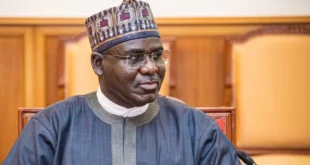
In his remarks, Minister of Information and National Orientation Mohammed Idris said Nigeria’s security challenges cannot be addressed by military force alone.
He therefore called for better intelligence, modern technology and stronger collaboration between security agencies and communities.
Idris, represented by The Voice of Nigeria Director General, Jibrin Ndace, said military operations remain necessary but must be complemented by measures to address conditions that allow criminal groups to recruit members and threaten the lives and livelihoods of citizens.
“The theme of this conference is particularly relevant because current security threats cannot be addressed by force alone. Military operations remain necessary, but must be supported by reliable intelligence, modern technology, effective coordination between security agencies and cooperation with communities,” he said.
The minister said President Bola Ahmed Tinubu’s Renewed Agenda of Hope places national security at the center of Nigeria’s development, adding that the administration is pursuing modernization of the military, intelligence-led operations, improved surveillance and greater coordination between security and intelligence agencies.
He revealed that Tinubu, in August 2026, directed the preparation of a comprehensive national threat assessment and a five-year rolling strategic defense operational plan to enhance coordination, prioritize and guide resource deployment.
“This is an important step towards a more coherent national response to evolving threats,” Idris said.
He also said the president had approved pay increases of between 30 and 80 percent for armed forces personnel, starting in September 2026, describing the decision as recognition of the sacrifices made by security personnel.
According to him, safety initiatives must translate into tangible improvements in the lives of Nigerians, including safer communities and roads, protection for farmers and businesses, and an environment where children can attend school without fear.
On the role of the media, Idris said accurate reporting and responsible verification are needed to help citizens understand security developments and prevent rumors from creating panic or undermining military operations.
He, however, cautioned against interpreting responsible reporting as shielding government or security agencies from scrutiny.
“This does not mean shielding government or security agencies from scrutiny. Journalists must continue to ask tough questions and hold institutions accountable, while respecting legitimate operational sensitivities,” he said.