JamzNG Latest News, Gist, Entertainment in Nigeria
Home Secretary insists Nigeria’s borders are open, questions Atiku’s 2027 pledge on trade and security policies
By Raphael Ekpang
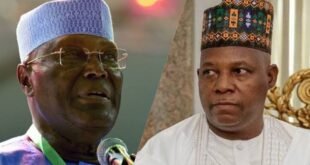
Abuja (Core Reporters) – The Minister of Interior, Olubunmi Tunji-Ojo, has rejected claims by former Vice President Atiku Abubakar that Nigeria’s land borders would need to be “reopened” if it wins the 2027 presidential election, insisting that the country’s borders are already open under a controlled border management regime.
The Minister made this known in the declaration personally signed on Saturday 29 August 2026.
Tunji-Ojo said describing Nigeria’s borders as closed overlooks the reopening of major land crossings by successive administrations and confuses legitimate trade restrictions with security measures imposed in response to insurgency and banditry.
The minister, who oversees the Nigeria Immigration Service (NIS), said the previous administration reopened the Seme, Illela, Maigatari and Mfum borders on December 16, 2020, with Idiroko and Ikom subsequently reopened for goods and services on April 20, 2022.
He added that the current administration reopened Kamba and Tsamiya in Kebbi State in February 2026, restoring further connections with Niger Republic and Benin Republic.
According to him, the history of Nigeria’s borders with Cameroon cannot also be reduced to the trade policy of 2019.
Tunji-Ojo explained that the closure of the Banki and Amchidé crossings was triggered by the Boko Haram insurgency in 2014 and was therefore security-oriented rather than a consequence of the 2019 trade policy.
It said the crossings were reopened in 2019, with Fotokol and Gambaru following in 2021, after joint military and stabilization efforts involving Nigeria, Cameroon, Niger and Chad.
The minister argued that presenting these developments as a prolonged border closure creates a misleading narrative by conflating two separate political issues: trade regulation and counterinsurgency.
He acknowledged, however, that not all northern border crossings currently operate without restrictions, stressing that tighter controls remain necessary in areas where banditry or residual rebel activity persists.
“Where banditry or residual insurgent activity persists, tighter control is a deliberate safety judgment, not negligence,” the Minister said, warning that reopening crossings before prevailing security conditions could expose traders and border communities to greater risks.
Tunji-Ojo argues that effective border management in the modern era should not be reduced to a choice between completely closing borders and allowing unrestricted movement.
Rather, he said, it’s about balancing national security with proper documentation, customs compliance and facilitation of legitimate trade and movement.
The minister therefore challenged Atiku, should he adopt a new border policy before the 2027 elections, to clearly outline what would change under his proposed administration, rather than presenting existing trade, security and infrastructure challenges as evidence that Nigeria’s borders are generally closed.
“Political competition should not become a competition to rewrite recent history,” Tunji-Ojo said.
He urged Nigerians to distinguish between border management measures introduced for economic and trade reasons and restrictions necessitated by security threats, saying both require different policy responses.